-
 (THOMAS WALLNER | THE GRAHAM LEADER) Graham Police Chief Brent Bullock speaks with the Graham City Council during their budget workshop Thursday, Aug. 7 regarding Flock Safety cameras. The city council voted to remove funding for the cameras from the proposed budget.
 -
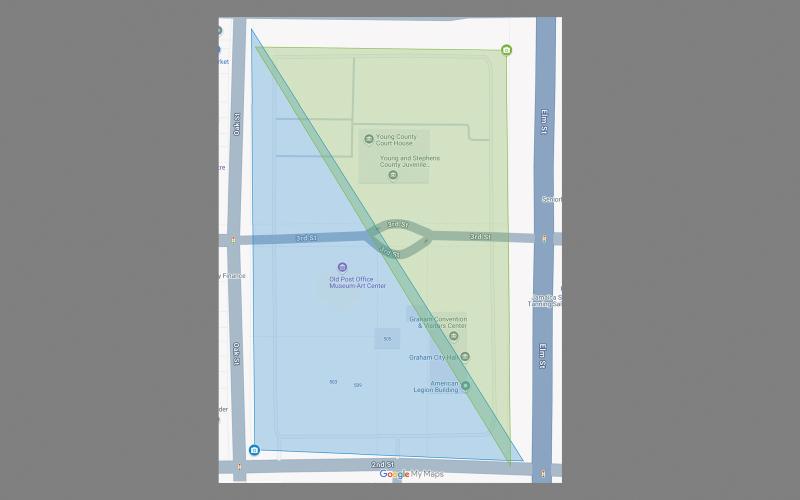 (CITY OF GRAHAM | CONTRIBUTED PHOTO) With the current proposed budget for Graham Police Department is two cameras at the corner of Second and Oak Street and Elm and Fourth Street to monitoring the downtown square.
After considering Flock Safety cameras utilizing license plate readers at each entrance to Graham, the city council removed funding for the project from the proposed budget.
Though the entrance cameras were not approved, funding has been allocated in the proposed budget for Flock Safety cameras at one intersection in Graham and for motioning the downtown square.
The Graham City Council met Thursday, Aug. 7 for a budget workshop where they voted on recommended amendments to the in-progress budget. One of these amendments was for the removal of funding for the cameras.
City Manager Eric Garretty and Police Chief Brent Bullock said the proposed cameras were to catch those who may have active warrants or who the city is actively searching for, such as a missing person.
The city was provided a quote from Flock Safety of $24,500 for six Falcon ALPR cameras and one Falcon LR camera using the FlockOS system along with installation. The $24,500 is the first year’s cost and it would have a recurring cost of $24,500.
“No one’s license plate will ever be put into this system unless they’re a suspect of Graham, Texas,” Bullock said in a previous interview. “It doesn’t go around just reading everybody and videoing everybody. I mean it is going to be there, but it’s not going to be used in that way.”
Council Member Jack Little said while he believes the system would be a benefit to the department and city, to him it was difficult to justify with a tight budget.
“When I look at this (proposed budget) book and hear what I’ve heard today, and where we’re at, we’re accountable to the citizens out here. We’re trying to raise tax rates, we’re (raising the rates for) water and sewer …we have to do what we have to do in my opinion,” he said.
Little said it was difficult for him to approve the $24,500 for the Flock Safety cameras and Council Member Jeff Dickinson said he agreed with his hesitation.
“I think at this point in time where we stand on the budget (we should) eliminate it from the budget for now is the direction I would go,” Dickinson said.
The council moved to decrease the expenses in the general fund for the Graham Police Department budget by $24,500, removing funding for the Flock Safety devices.
The LPR cameras from Flock utilize artificial intelligence and can identify vehicles by make, color and decals. Law enforcement can also search by the radius of a location with identifiers.
According to Flock Safety, the cameras capture and organize vehicles into categories based on make, model, color, resident or non-resident vehicle, timestamp, type of plate and damage or alterations.
“It just reads the license plate and basically puts a fingerprint on the car. It doesn’t run the license plate and tell you who it belongs to. It will tell you that this vehicle suspect is so and so, last seen driving it was armed and dangerous or just has a warrant,” Bullock said. “It’s a standalone system outside of (Texas Crime Information Center) and (National Crime Information Center).”
Vehicles can be narrowed to body type such as cars, SUVs, trucks, buses, motorcycles, bicycles and more. Flock Safety cameras do not have speed detection capabilities.
The cameras and license plate readers were proposed to be placed at the city’s entrances at Hwy. 380 North, Hwy. 380 West, Fourth Street, Hwy. 16 North, Fourth Street and Cliff Drive, Hwy. 16 South and Hwy. 67.
Garretty and Bullock said the cameras were not going to be utilized as an active surveillance system, but can help with things such as pinging certain vehicles.
“The program allows you to put what they call hot vehicles in it. If we had a stolen vehicle in town and the first thing they do is get out of town, we would be able to know where that vehicle left from and which direction they went, just by putting that information into Flock. And so would every other agency around us, because once we put it into Flock, it goes statewide (and) nationwide,” Bullock said.
Despite removing funding for the cameras at entrances to the city, Bullock said Thursday that within the proposed GPD budget are still cameras for the downtown square.
“There’s going to be one on the south side of the square and one on the north side of the square because we’re experiencing things that we really never experienced before during our big events,” Bullock said. “Last week we had a vehicle taken and then at the start of the Summer Concert Series we had vehicles broken into unconventionally by busting the windows out and things taken out of vehicles.”
The two downtown square cameras from Flock Safety are Condor PTZ live video cameras. The city was quoted two Condor PTZ cameras and an installation fee for a first year cost of $7,500 and a recurring cost of $6,000.
The downtown cameras can alert vehicles, individuals in an area and provide live view for incidents. The camera uses artificial intelligence to identify human presence without recognizing characteristics.
The police chief said in a previous interview the downtown cameras would be utilized to monitor the Young County Courthouse, Graham City Hall and for review of wrecks downtown.
“There is a way to have a live view, but it’s not like we’re going to be sitting there watching that live view. It’s going to be for graffiti, vandalism, criminal mischief, burglaries, for that purpose,” Bullock said in a previous interview. “...This gives us cameras downtown to protect our downtown district and area.”
In July, Young County was awarded a Catalytic Converter Grant from the Texas Department of Motor Vehicles Motor Vehicle Crime Prevention Authority. The grant awarded was $78,400 and requires a $19,600 matching grant from Young County.
This funding will be used to purchase Flock Safety cameras to help deter vehicle theft in Young County. The county is looking to partner with the city of Graham and city of Olney and use Senate Bill 22 funding to pay for the Young County portion of the system.
“(The grant is) going to allow (the county) to establish these Flock operating systems throughout the county,” Garretty said. “...In Graham, at least in one location… where Hwy. 16 and the 380 bypass and Hwy. 67 come together, they’re going to put up a full set of camera systems. There will be four license plate readers and a video camera. They would like for us to participate in it.”
The county requested $1,700 from the city of Graham to help cover the cost of cameras at the Hwy. 16 N, Hwy. 67 and Hwy. 380 Bypass intersection in Graham where cameras will be installed.
During their budget workshop Thursday, the city council authorized an amendment to the proposed budget with the addition of $1,700 to fund the Flock camera installation in participation with Young County.