-
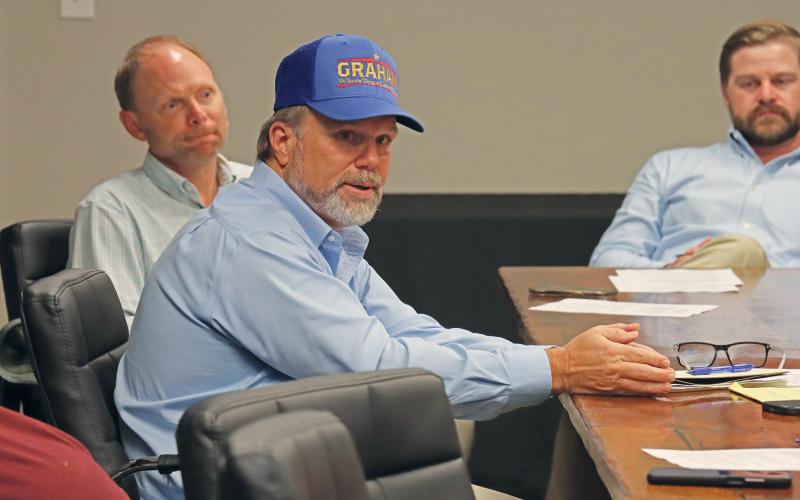 (THOMAS WALLNER | THE GRAHAM LEADER) City Manager Eric Garretty speaks to the Downtown Development District 1 board during their meeting Tuesday, Sept. 3. Shown from left to right are board member Brendan Weatherman, Garretty and Assistant City Manager Grant Ingram.
The city of Graham is in the early stages of pursuing a grant through the state Downtown Revitalization Program and is tasking the Downtown Development District 1 board with recommending potential grant projects.
The Texas Department of Agriculture Rural Community Development Block Grant (TxCDBG) category called the Downtown Revitalization Program (DRP) has a max award of $1 million. This grant provides funds for public infrastructure to eliminate deteriorated conditions and promote economic development in historic main street areas and rural downtown areas.
For the October meeting, the DDD1 board is looking to have a recommendation on the agenda that if funding was available through the grant, the board would prioritize sidewalks, including ADA accessibility, and improve existing restrooms.
City Manager Eric Garretty spoke about a project presented to multiple city boards to close Third Street and create a pedestrian area which was to be privately funded and not use city funding. Part of the funding for that project could be covered using the grant opportunity.
“It has a lot of restrictions on it. For example, you can use it to renovate things other than sidewalks, but it's primarily geared towards sidewalks. So 51% of all the money spent on a given DRP project has to be spent on sidewalks and it can't be spent on parking, it can't be spent on landscaping and it can only be spent on certain types of lighting. ...There's a laundry list,” he said. “...There were thoughts of working the DRP... into the Third Street project as a way to help fund it.”
The board spoke on the project and board member Jack Little asked what the public response has been on the Third Street Commons project. While Little said he heard negative comments regarding the project, the other board members said they heard only positive comments.
Board member Brendan Weatherman said utilizing the potential of $1 million through the grant could be seen better for the bathroom and ADA components rather than the Third Street project.
“I just think that's something that people, business owners, would recognize and see the value in that to keep people down here and the accessibility of more people being able to get into their stores that may or may not be able to right now, than a beautiful landscape, total square project,” Weatherman said.
The city manager spoke with Mayor Alex Heartfield regarding coming to the DDD1 board with their suggestions on projects should the Third Street Commons project not materialize. The board could present a list of projects for the Graham City Council to consider if the grant was awarded.
“You could look at this list of projects that DDD1 suggested... or you sink all your Downtown Revitalization grant money into Third Street Commons,” Garretty said. “...What we're doing, or attempting to do as a group, is develop options for the council when it comes to this Downtown Revitalization grant, which isn't guaranteed, but there is allegedly more funding for the program statewide than there's ever been.”
The board spoke about expanding handicap access and bathroom availability on the square. The grant awards are based on a scoring system, with handicap access giving more points.
“One of the things that they really like and gets you points (on the grant scoring) is going around everywhere where there's not what they call zero-entry access, that's access for the handicap. Have intersections with all four corners with zero-entry access, that type thing, and that gets expensive pretty quickly,” Garretty said.
With the city adding ADA accessibility to the mural on the side of City Hall they were able to make an estimate of the cost of a potential project on the square.
“I think for the status that we are, and let's make an assumption that... we would have to redo all four corners of each intersection, I think as long as concrete prices remain reasonable, you're probably looking at somewhere between $100,000-150,000 per intersection,” Garretty said.
The city manager encouraged the board to look around the square and research accessibility and where it needed to be addressed.
DDD1 Board President Cathy Partridge said even with the public bathroom on the square, availability is an ongoing issue for events such as the Summer Concert Series. The city manager said they have worked to see what could be done to alleviate the issue.
“We did some initial engineering estimates. We think we could reconfigure and expand the existing bathroom. So do a combination of rehab, more or less, gut the interior, expand the square footage and then make a larger male and female side,” Garretty said. “The reason you would do that versus building something new... is you save a lot of money because all the plumbing and electrical is already there.”
Garretty said with that expansion the city could increase capacity by an estimated 25% while upgrading the facility. The upgrade and expansion would not impact the Young County 1921 Jail which is near the property.
“It wouldn't touch the jail,” the city manager said. “...It seemed to be the most cost-efficient way to do it was to reimagine the existing bathroom.”
The city manager said the goal for the DDD1 board is to establish a list of items that could be brought before the city council. The public then could come to the council meeting and voice their support or concerns.
“To me, that's what we should be doing is collecting up what facts we can, making some assumptions to come up with some concepts, and then put it there so that you and other members of the public can come to a hearing,” Garretty said. “...It's not black and white, even among this group. ...At least have the public policy debate about which one do we think would best serve the citizens of Graham. That's what I'm trying to set up, and I think that's worthwhile.”