-
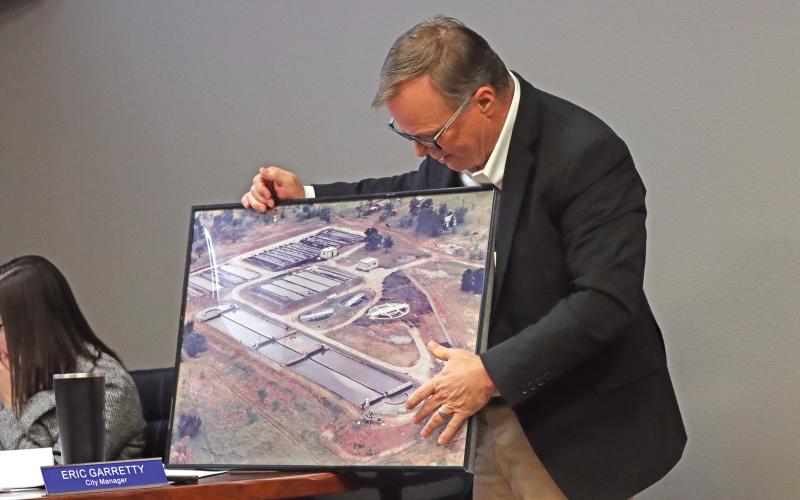 (KYLIE BAILEY | THE GRAHAM LEADER) City Manager Eric Garretty discusses portions of the wastewater treatment plant to the Graham City Council and community watching their meeting Thursday, Jan. 23. The city approved to hire Freese and Nichols as engineers to plan improvements at the facility.
The Graham City Council is preparing for the future as it looks to address concerns regarding its aging wastewater treatment plant. They took the next step last week, hiring an engineering firm to develop renovations options for the council.
The city council Thursday, Jan. 23 approved Freese and Nichols to produce a new Wastewater Master Plan and conduct predesign services for a proposed project to rehabilitate the wastewater treatment plant.
“We're beginning what will probably be a four-year journey, and that is to develop a wastewater plan that will make sure that the needs of the community when it comes to wastewater are met for the next 20 to 30 years,” City Manager Eric Garretty said. “We're (also) doing an update to our currently failing infrastructure at the wastewater treatment facility, a plant that was built in 1980.”
The city council established an Engineering Provider Evaluation and Selection Committee during their meeting Thursday, Dec. 19. That committee recommended Freese and Nichols as the most qualified proposer over Jacob and Martin, Kimley-Horn and Parkhill.
“As a member of the selection committee, I learned a lot about what we have out there. ...We have a very qualified wastewater manager out there that knows the insides and out,” Council member Jeff Dickinson said. “...I was surprised that in (2013) was the last master plan. ...So we have something to work off of that these guys can actually do, but the council never acted on that initial study of 12 years ago. I think it's going to be on us to move forward with this project and make sure it is a priority.”
The city set three project objectives that they are looking to achieve if they have the funding, which were presented to the council by the city manager.
“We're going to update and revise the city's current wastewater treatment master plan to reflect plan improvements under the rehabilitation project at a minimum, rehabilitate the entire plant, construct new infrastructure for plant resilience and create storage capacity for reuse water,” Garretty said.
The engineering firm will be producing three pricing alternatives to present to the council with proposed costs of completing those upgrades.
“At a minimum, what we're looking to do with this product with this project is (to) repair existing driving beds, replace gear boxes on all clarifiers, replace all paddle wheels on the oxidation ditch to include rehabilitation of mounts (and) increase the volumetric capacity of the chlorine contact chamber,” Garretty said. “(We also want to) repair (and) replace mechanical, electrical plumbing as needed, install a full SCADA (computer monitoring) system… and build new plant operations headquarters.”
The city manager said raw sewage is pumped through a grate separating big solids and moves into the oxidation ditch. The water moves through paddle wheels that aerate and oxygenate the water causing the solids to start settling.
“That's the first step in the treatment process,” Garretty said in a previous interview. “These paddle wheels are very old. They break all the time. Some of them are so old they don't make parts for them anymore. We have to machine them.”
Garretty said the oxidation ditch is a crucial element of the water treatment facility and something that it could not function without.
“If this oxidation ditch fails to the point where we can't run the raw sewage through there for the initial phase of the treatment process, we can't process sewage. ...It's a single point of failure in our plant,” Garretty said.
In a previous interview, Garretty spoke about probable cost estimates for the proposed project and how it will require an increase in city sewer rates.
“In order to do this project, there will have to be some sort of rate increase on the sewer,” Garretty said. “But the real thing is, how much? Is grant funding available? Are there low interest loan alternatives through the state? All those types of things will help to mitigate how much of an increase it is.”
When compared to other cities across the state repairing their aging water treatment facilities, the city said the estimated project cost could be in the $12-15 million range.
The city manager added that until the engineers look over the data and price that out, they will not have a definitive number.
The estimated time project timeline is predesign taking four to six months, debt acquisition taking around four months, permitting taking around three months and a significant period for construction.
“I'm estimating construction will take anywhere from 18 to 24 months, and certification will take one month,” Garretty said. “That's 45 to 50 months from the date you take the action to get the engineers working on it.”
One thing the city manager made clear to the city council was the necessity in moving forward on the project now due to the length of time from planning to construction.
“If we delay action on this and don't find a way to move forward with this project we're just putting ourselves further and further behind,” Garretty said. “In the city manager's opinion, before we can complete this project, we are almost certain to see additional failures of key infrastructure at the wastewater treatment plant.”
For more on the story, see the previous coverage here.