-
 (THOMAS WALLNER | THE GRAHAM LEADER) Comprehensive Plan Advisory Committee Vice Chair Johnny Ford speaks during the first meeting of the board Thursday, Oct. 16. The board was tasked by the Graham City Council with establishing a plan for future consideration.
 -
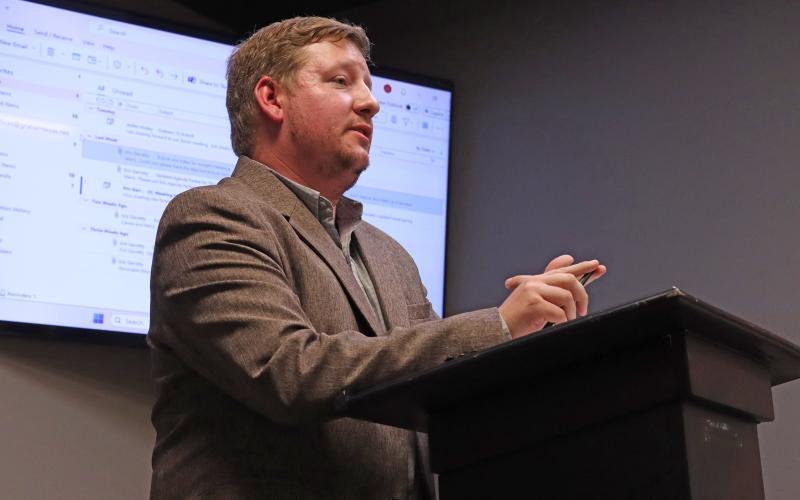 (THOMAS WALLNER | THE GRAHAM LEADER) Dalton Aiken with Public Management Inc. goes over aspects of the planning process for the city comprehensive plan. The city will work with the company along with others to develop a plan for the future of Graham.
 -
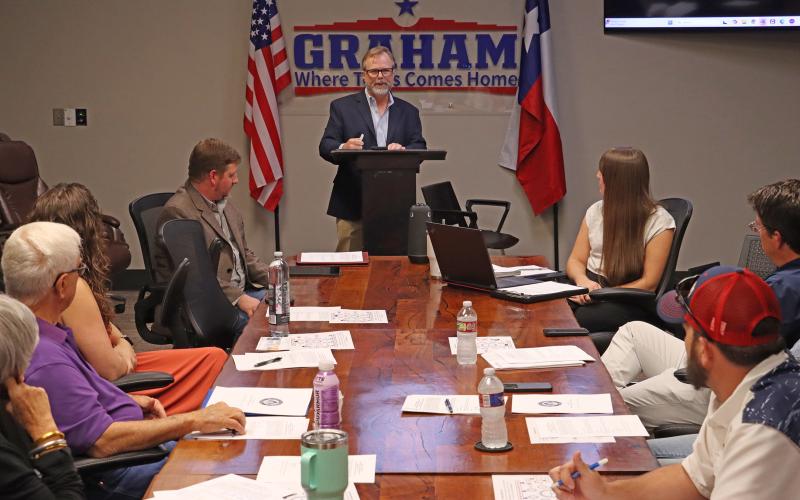 (THOMAS WALLNER | THE GRAHAM LEADER) City Manager Eric Garretty speaks with the Comprehensive Plan Advisory Committee during their first meeting Thursday, Oct. 16. The group will be working to establish a comprehensive plan for presentation to the Graham City Council.
Work is underway to chart the future of Graham as a city comprehensive plan is under development utilizing feedback from a recent community survey.
The Comprehensive Plan Advisory Committee met Thursday, Oct. 16 and were presented the survey results from Dalton Aiken and Caitlyn Higgins of Public Management Inc., the grant administrators and planning firm for the project.
“The Texas General Land Office set up a grant program that would allow communities to do these types of comprehensive plans,” City Manager Eric Garretty said. “Their focus is on hazard mitigation and zoning, but there’s a lot of other things that go into a comprehensive plan. But all this work that you see is being funded directly by a $300,000 grant from the (GLO) to do this project.”
The grant awarded to the city had a start date of April 9, 2025 and an end date of June 30, 2028, with Aiken stating that they are not expecting the plan process to take three years. He said the company is seeking to finish the project in around 18-24 months.
A comprehensive plan is a growth and development plan for the city. In July, the city council approved forming a Comprehensive Plan Advisory Committee committee to provide input to the city council regarding development of the plan.
The community survey was opened in September and ended Friday, Oct. 10, with both a digital and paper option available for residents and nonresidents.
The key takeaways from the survey results addressed housing access and affordability, roadway and utility repairs and pursuing growth without compromising the community.
The survey is the foundation for public engagement in the comprehensive planning process.
The survey received a total of 868, or a 9% engagement rate across the city’s population of 8,758. Public Management Inc. Planner Caitlyn Higgins said this result was a positive response rate.
“When you’re looking at just the city’s adult population, which is typically the ones that would be in respondents to the survey, the ones paying city taxes …that goes all the way up to about 13.2%,” Higgins said. “This is an amazing response rate compared to what we see in other cities. We typically shoot for somewhere between 5% and 8%.”
A total of 708 of those surveys, or 81.6% were those that said they were Graham residents, with the remaining saying they were outside Graham but within the region such as Young County, Newcastle, Bryson, South Bend and more.
Those between the ages of 35 and 64 accounted for 58% of the total respondents, with those 65 and older accounting for 25%. Of those surveyed, 63% lived in Graham for more than 15 years.
“We were able to get a lot of people that have been here for a very long time, that were able to experience changes in infrastructure, changes in growth and development, changes in political standings within the city, all that type of stuff,” Higgin said. “Those responses become very useful, because it’s people that have seen the ebbs and the flows of the city and can give input on the future.”
For public service satisfaction, the respondents rated fire, police and emergency medical services with the highest confidence, while public works, animal control and code enforcement were ranked lowest.
Regarding the city’s development over the past few years, 34% of respondents were neither satisfied nor dissatisfied, 26.1% were satisfied and 25% were dissatisfied, with the remainder very dissatisfied or very satisfied.
Housing availability and affordability was a major concern for those who responded in the survey, with 23% saying housing availability was terrible, 40.4% stating it was poor and 31.4% stating it was average.
Likewise, 39.8% of respondents said housing availability was terrible, 35.6% said it was poor and 20.8% said it was average.
The public recognized police, fire and ems response time and approved public events, parks space upkeep and community-centered programs. There was positive feedback on downtown improvements and community charm.
The highest contention was with street conditions and road repair, code enforcement consistency and property conditions, housing supply and cost of living and transparent development communication.
The ranking for responders for infrastructure in order of priority was housing, streets, water and wastewater, drainage, parks and recreation, street signs and signals, lighting, sidewalks, city facilities and parking.
The city manager and public works director said the city is shooting for a goal of $1 million in resurfacing projects, which accounts for 5-8% of streets. The city manager said the comprehensive plan could address a higher percentage at once through a capital bond or similar process.
“Seventy-five of the streets in Graham at a minimum need some type of work that we’re doing at a rate of about 5-8% a year,” Garretty said. “We’re playing catch up on a game that will never catch up on a million dollars.”
Respondents’ long-term vision in order of priority were quality housing and neighborhoods, resilient infrastructure, sustainable economic development, health and education availability, improvement of public safety, efficient city expansion, preserving natural resources, enhancing resilience and preparedness, historical preservation and diverse transportation options.
A requirement of the GLO grant is two to three town hall meetings, with the first serving as an open house.
The first town hall with preliminary findings will be held 5:30 p.m. Monday, Nov. 17 with a location to be determined. The company will also have their planning team available with different stations with information regarding their studies.
“Our firm is very big on being in the community and trying to understand what’s going on, not just from the appraisal district or Census data,” Aiken said. “We drive around every single street, we look at every structure, we categorize the existing land use that way and that’s kind of our assessment. We’ll also look at existing plans and we also have another partner that drives around and looks at all the streets.”
The company has set up a website called a ‘planning hub’ that can be used by the committee as the plan is developed. The hub will be updated with changes within the plan and members of the committee can provide feedback to the company.
An online public website with the data found will also be available in the future.