-
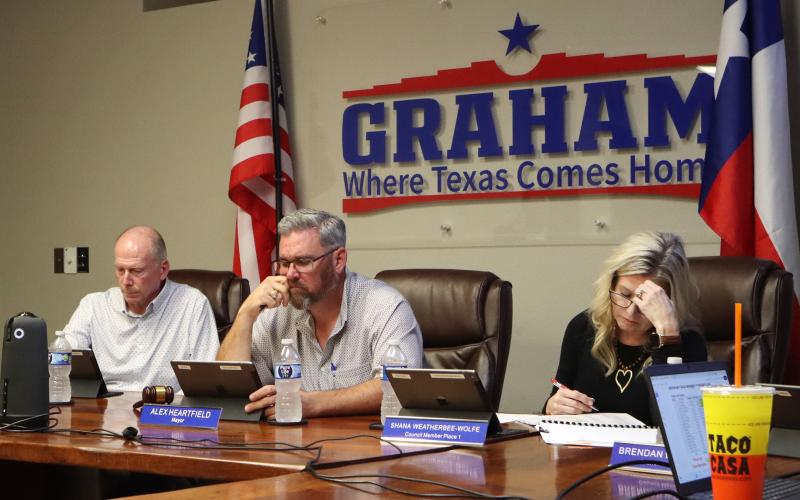 (THOMAS WALLNER | THE GRAHAM LEADER) Members of the Graham City Council listen to a presentation from City Manager Eric Garretty regarding the upcoming fiscal year budget. The council began discussions on the budget during their meeting Tuesday, Feb. 17 as they work to address a number of key issues in the city.
The city of Graham took the next step during a budget workshop in its pursuit of potential debt for a rehabilitation project at the wastewater treatment plant and the purchase of a new fire truck.
During the workshop held Tuesday, Feb. 17, the city council approved pursuing a new fire truck for Graham Fire Department which was included in a Notice of Intent (NOI) to issue Certificates of Obligation (COs) not to exceed $14.6 million along with a wastewater plant rehabilitation project.
“(A total of) $12 million dollars will be reserved for phase one of the wastewater treatment plant rehabilitation,” City Manager Eric Garretty said. “...It will include a replacement of failing electrical infrastructure, construction of failing piping and plumbing that resistance discovered from the oxidation digital clarifier and construction of a combined electrical room and operation center.”
A total of $2 million will be reserved for the new fire truck while the remaining $600,000 will cover the estimated cost of acquiring debt such as regulatory fees, closing costs, professional costs and bond insurance.
“We’re confident it’s going to be some number south of $2 million if we act within the next year. But having done this before, that doesn’t buy you everything that you need to outfit the truck. There’s going to be other equipment that we have to buy, and we might as well buy it with this money, because the cash is not available,” Garretty said.
The city manager needed direction from the council members if they wanted to pursue purchasing a new truck or looking at $50,000-75,000 worth of repairs to the existing truck, with a decision made to pursue the purchase of a new vehicle.
“We’ve tried (fire truck) grants in the past. I went to a CDBG (Community Development Block Grant) workshop at Nortex. They have a program where there’s a $500,000 grant. You wait three years for it, there’s no guarantee that you can get it and it’s a priority to the communities with the lowest adjusted medium household income,” Garretty said.
Nick Landes and John Lopez of Freese and Nichols presented a preliminary design report and option of probable construction costs for the wastewater treatment plant rehabilitation project during the city council meeting Thursday, Feb. 5.
Two phases were presented to the city council, with the first estimated to be bid in 2028 and the second to be bid in 2030. The total cost of both phases was estimated at $35.8 million.
Phase 1 was estimated to be a total cost of $19,260,000, with the largest items being electrical and power signal distribution at $5.37 million, construction of an administration and electrical building at $3.2 million, construction of an ultraviolet (UV) disinfection facility at $1.5 million and Return-Activated Sludge and Waste Activated Sludge improvements at $1.44 million.
“(Phase 1) improvements, they’re really important, really critical, but it still takes a long time to construct. So getting electrical infrastructure, there’s long lead times on that electrical gear, and so we’d expect that to be online close to the end of 2029,” Landes said.
The city’s wastewater treatment plant was built in 1978, with age impacting a number of components. Landes said the electrical infrastructure is on “borrowed time” and must be addressed.
“(Public Works Director) Randall (Dawson) and I went back to our engineers that you had a presentation from on the sewer plant. ...As they dug into their numbers more, they think the first thing we’ve got to do is get the electrical right,” Garretty said.
The engineer recommended a combined administration and electrical building to get the electrical infrastructure in an air-conditioned, controlled environment that could last for 20-plus years.
The duct banks which house the wires moving from place to place are in poor condition and showing wear. Many of the duct banks in the facility are original from 1978 and would need to be moved if a new facility is constructed.
Senior Managing Director of Hilltop Securities Jason Hughes, the financial advisor hired by the city, spoke with the council Thursday, Jan. 8 regarding the debt options available.
The city discussed three types of debt issuance which were general obligation (GO) bonds, COs and tax anticipation notes (TANs). COs are not subject to a bond election but city council approval through a NOI.
“COs are normally used to fund what I call the day-to-day projects. So they’re the projects that are needed to keep the city moving again day to day (such as) water, sewer, drainage, streets, public safety going to be in the big ones there. You can also do renovation to existing buildings, things of that nature,” Hughes said.
NOIs are required to run for two consecutive weeks in the newspaper of general circulation and are required to run 45 days beforehand due to the fact that they are subject to petition.
“If you have 5% of your registered voters petition it, it can effectively force the COs to a (GO) bond election. So that’s the mechanism by which your citizens have more input into that CO notice,” Hughes said.
The NOI is the maximum number the city would need to borrow and, once approved, the council cannot exceed this number.
“We can borrow below this number if we find that we can do that, it’s safe and it makes sense. This is a maximum number that we set in the notice of intent. Council is not bound to borrow that amount,” Garretty said.
The city manager said the reason for asking $12 million in phase one of the wastewater treatment plant rehabilitation is in case of more repairs needed at the plant.
“One of two things will happen. Either we’ll have some type of major infrastructure failure at the sewer plant before we can get this three-year project completed, and we’ll need to have cash on hand to do it, or if we don’t have to do that, it simply means we don’t have to borrow more money in the next tranche,” Garretty said.