-
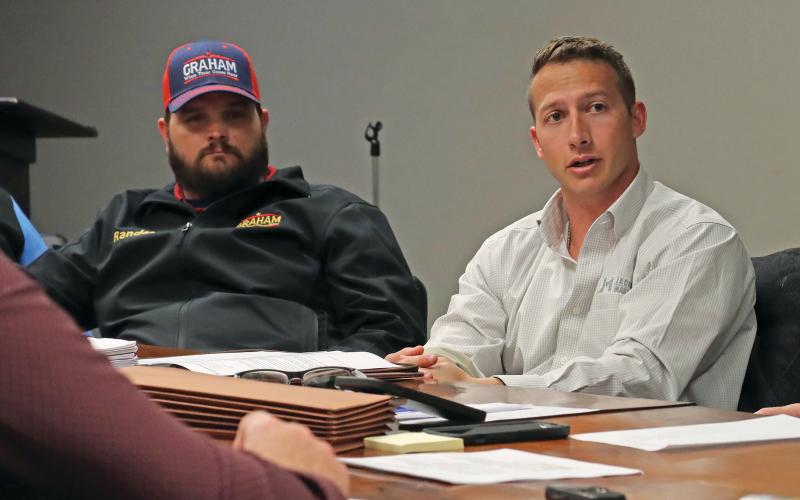 (THOMAS WALLNER | THE GRAHAM LEADER) Jacob and Martin Project Manager Tristan King (right) speaks with the Graham Parks Department Board of Directors during a February 2024 meeting. The company was approved in July to assist the city with the scope and cost of a lead service line inventory.
 -
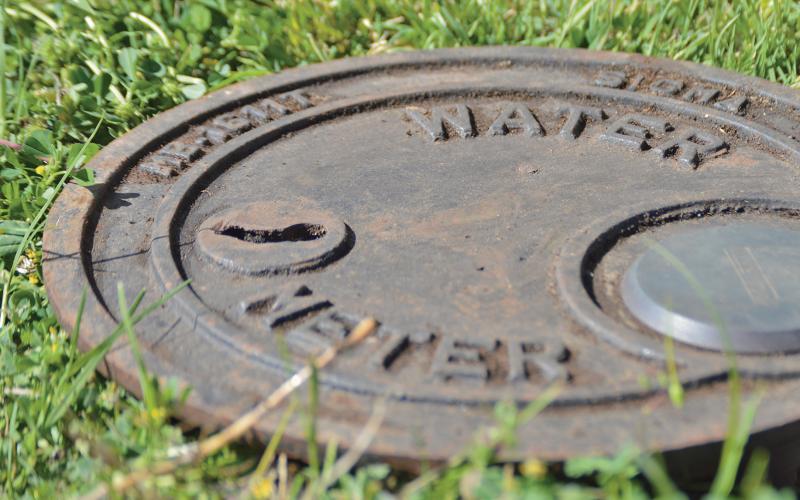 (ARCHIVE PHOTO | THE GRAHAM LEADER) A water meter lies buried in Graham on Second Street. The city is looking to complete a lead service line inventory in order to comply with a directive from the Texas Commission on Environmental Quality and the U.S. Environmental Protection Agency.
A capital project of up to $600,000 for a lead service line inventory is moving forward after discussion from the Graham City Council this week.
The cost and scope of work for a lead service line inventory was presented to the city of Graham by its contracted engineering firm Jacob and Martin as the city works to remedy a violation from the Texas Commission on Environmental Quality.
Council members and City Manager Eric Garretty spoke on the estimates provided to look for a way forward for the city. The council granted the city manager the authority to create a capital project for the project so the city would have movement on the project.
“It's not saying we're going to spend the $600,000, but it's a budget marker against that in the Lakes Fund. Y'all will still have to authorize the contract, but we can say we've created a project and the council has formally appropriated funds toward the project,” Garretty said.
TCEQ required the city to send notice to residents in June regarding noncompliance with a lead service line inventory requirement in place from the U.S. Environmental Protection Agency.
The city did not comply with the October 2024 deadline to submit an initial lead service line inventory.
The city contracted with Jacob and Martin in July to determine the probable cost and scope of a lead service line inventory, which was received by the city last week. Approximately 4,351 service lines will need to be inventoried.
An opinion of probable cost for the lead service line inventory and removal and replacement of the lead service lines, both with Texas Water Development Board (TWDB) funding or local funding were provided by Jacob and Martin.
With local funding, the lead service line inventory is estimated to cost $374,958, with a cost of $100 per service line for the 4,351 lines identified. This includes a 10% contingency along with non construction costs such as basic engineering and planning.
Using the TWDB funding, the project is estimated to cost $576,324, with a cost of $100 per service line for the 4,351 lines identified. Along with more for the mobilization, bond and insurance, there is an additional $68,801 in the nonconstruction costs using this method.
Those nonconstruction costs are for basic engineering and planning, the application, water conservation plan, financial advisor, bond counsel, fiscal and legal and the loan orientation fee.
The biggest ticket item comes from the potential mitigation cost for the replacement of lines.
The estimate from Jacob and Martin has a total cost of $6,196,755 for replacement of lead service lines between construction and nonconstruction costs.
“The likelihood is that the city is going to have to go out for a loan to do the replacement part, which is going to further burden all of our ratepayers by causing a further increase of their water rates to debt service this loan,” Mayor Alex Heartfield said.
The construction costs include $50,000 for mobilization, bonds and insurance as well as $1,875 per line replacement for 2,180 lines identified. The cost also includes a cost of $500 per line for removal for the same number of lines.
“This is their high side number (to replace lines), if you make the planning assumption that you survey 4,351 lines and half of them, (or) 2,180, have to have something done to them,” Garretty said. “(Public Works Director) Randall (Dawson) and I think that number may be high. It's probably not going to be in the 2,000s. We could be wrong, but we would be surprised if it's in the thousands.”
The construction cost is estimated at $5,750,250 with a 10% contingency of $522,750. The non-construction costs are estimated to be $446,505.
In 2021, the EPA revised the Lead and Copper Rule Revisions to include protective measures to reduce lead and copper exposure through drinking water.
The Lead and Copper Rule Improvements were to reduce the exposure of lead in drinking water, inform communities about the risk of lead in drinking water and develop plans to replace lead pipes.
A Lead Service Line Inventory (LSLI) must include the inventory of all service lines in the water distribution system, including utility and customer-owned lines.
Lead status can be classified as Lead, Galvanized Requiring Replacement, Non-Lead or Lead Status Unknown.
“Customers with lead service lines, galvanized lines requiring replacement, or service lines with unknown material should be notified within 30 days of submitting the inventory,” Jacob and Martin stated in the technical memorandum.
“All customers should be notified of lead action level exceedance (ALE) as soon as feasible, but no later than 24 hours after discovering the lead ALE.”
The city was presented with an option of using the TWDB Drinking Water State Revolving Fund (DWSRF) Lead Service Line Replacement (LSLR) program. This funding source will provide assistance for the planning, acquisition, design and construction of water infrastructure.
The process for applying for the DWSRF will involve a pre-application process with project solicitation and an Intended Use Plan (IUP) along with a full application to receive funding.
The city must submit a Project Information Form (PIF) by the TWDB deadline which includes a project description, maps of the service area and estimated cost of the project. The submission window for the PIF opens in December and closes in March.
PIFs are reviewed by TWDB and ranked to create a prioritized project list which will receive an invitation to participate in a pre-application meeting. An application will be submitted to TWDB for consideration for funding.
Applicants must meet the disadvantaged criteria to receive funding under the DWSR-LSLR program to be eligible. Disadvantaged cities are those where 51% or more of the proposed project area has an annual median household income level (AMHI) that does not exceed 150% of the state’s AMHI.
Based on the 2023 Census data, the state’s AMHI is $75,780 and the city has an AMHI of $58,525, and is eligible for the program.
The funded project must replace the entire lead service line, which includes both the utility owned and customer owned portions of the service line.
“To penalize cities and in turn (water ratepayers) to replace a consumer's line that goes from the meter to their house is an overreach and is unreasonable, and we've said that to (U.S. Rep.) Roger Williams. They're fighting it on their end. I don't think they're going to get anywhere. It is unlikely that they will get the EPA to withdraw from this program,” Heartfield said.