-
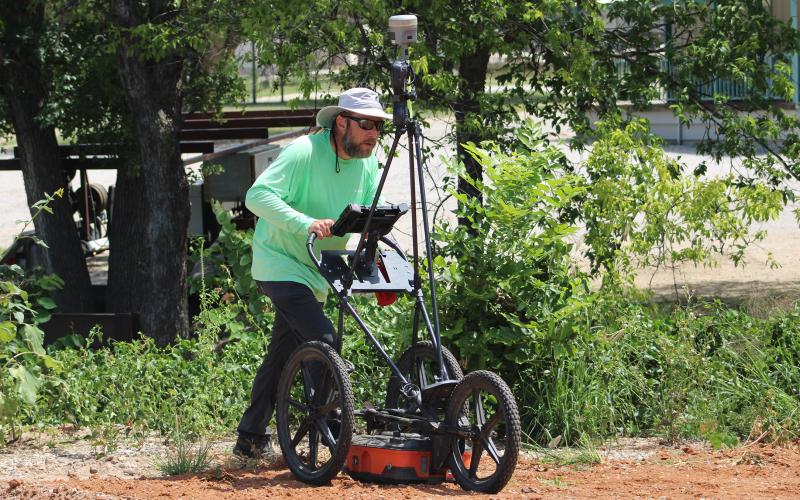 (ALEX HAVARDANSKY | THE GRAHAM LEADER) A ground penetrating radar survey is conducted Monday, July 14 by Dan Kieninger with Texas Cemetery Restoration at the Oak Grove Colored-William P. Johnston Cemetery. Shown is Kieninger pushing a GPR cart in an area behind the cemetery.
 -
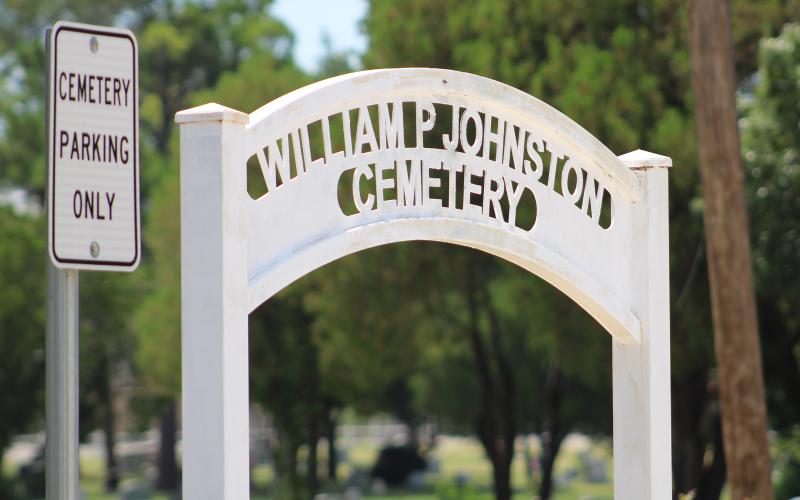 (ALEX HAVARDANSKY | THE GRAHAM LEADER) A sign at the Oak Grove Colored-William P. Johnston Cemetery that was part of new fencing put in by the Young County William P. Johnston Preservation Committee. Old fencing around the cemetery was removed and the fencing received a new coat of paint from Young County 4-H volunteers.
 -
 (ALEX HAVARDANSKY | THE GRAHAM LEADER) Dan Kieninger with Texas Cemetery Restoration performs a ground penetrating radar survey Monday, July 14 at the Oak Grove Colored-William P. Johnston Cemetery. The survey was approved by the Young County Commissioners Court the same day.
Following a presentation to the Young County Commissioners Court, Texas Cemetery Restoration was approved to use ground penetrating radar to search for unmarked graves at the Oak Grove Colored - William P. Johnston Cemetery.
GPR uses electromagnetic radiation in the microwave band of the radio spectrum and detects the reflected signals from subsurface structures. Detections can include objects, changes in material and voids and cracks.
Dan Kieninger with Texas Cemetery Restoration spoke with the commissioners during their meeting Monday, July 14 about completing the process at the cemetery located at 701 Hwy. 380.
Kieninger said the process would take one day to complete and will determine the location of unmarked burials using GPR data.
“The radar is non-evasive. It looks like a three-wheeled baby jogging cart with a box hanging off the bottom that we push back and forth like we are mowing the cemetery in a grid pattern perpendicular to the burials,” Kieninger said.
The mapping process involves pushing the GPR cart in a zig-zag pattern over the entire cemetery. Once completed, Kieninger will process, analyze and interpret the data to determine where the unmarked burials are located.
“It’s not X-rays, we’re not going to see bones,” Kieninger said. “What the radar is detecting is changes in density of the soil.”
As the data is being recorded, the GPS system within the GPR cart inserts exact locations into the GPR data every second, according to Texas Cemetery Restoration.
A map of the surveyed area showing the location in relation to the marked burials and other elements of the cemetery will be provided to the county.
“It’s not 100% accurate,” Kieninger said. “If the remains are back ashes to ashes and (there is) nothing left, there’s a possibility that nothing would be detected.”
The map will show the areas with high probability of being unmarked burials with the latitude and longitude of the burials. Included also is the installation of stainless steel discs at locations of unmarked burials, with up to 100 burials.
“It’s more of a historical designation to let you guys know where they possibly are and if they are adjacent to some marked burials they could possibly be researched to make a sense as to who might be buried there,” Kieninger said.
Young County Judge Win Graham said the county could only authorize Texas Cemetery Restoration to complete the survey within the land owned by the county.
The commissioners approved the cost for the survey for $3,650 quoted from Texas Cemetery Restoration for 0.25 acres.
Since the beginning of March 2024, Dr. Tamra Walter, a historical archaeologist and associate professor of archeology at Texas Tech University, along with students and the descendant community have worked to unearth the history of the Young County cemetery.
The research team spent three weekends at the cemetery and determined most of those buried in the areas they studied were from Graham and Olney.
Rev. Vanessa Sims first shined a spotlight on the cemetery’s condition. Sims has been working with multiple entities to push for answers for not only herself, but also other descendants.
Sims, who lives in Denton now, was born in Olney and her mother lived in Graham. Her sister Marie Ann East, who was born prematurely in February 1952 and died in the same month, was supposed to be buried in the colored section of Oak Grove Cemetery, but her grave is currently unable to be located.
While using GPR at cemetery was a goal of the research team, they still are looking to conduct a survey of the Hwy. 380 bypass to determine if there are burials underneath the highway.