-
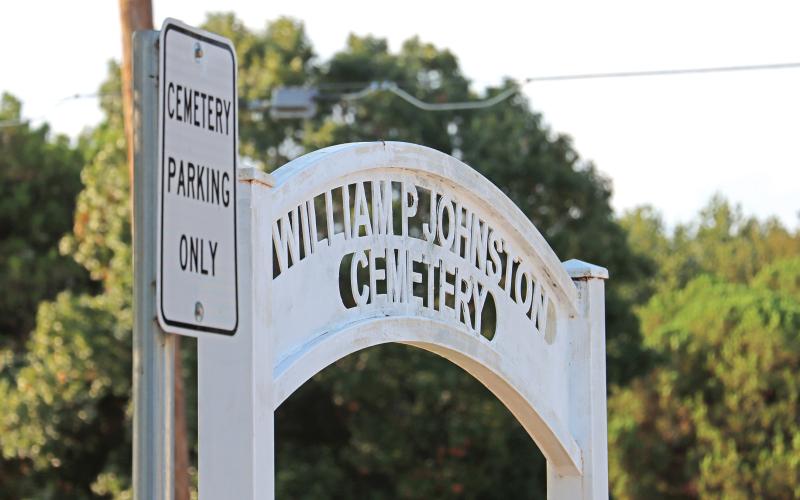 (THOMAS WALLNER | THE GRAHAM LEADER) The entranceway to the Oak Grove Colored - William P. Johnston Cemetery along with a sign showing parking at the cemetery. A ground penetrating radar survey found 14 possible unmarked graves in the city of Graham-owned cemetery parking area.
 -
 (THOMAS WALLNER | THE GRAHAM LEADER) A pvc pipe and flower mark a potential unmarked grave found by researchers from Texas Tech University at the Oak Grove Colored - William P. Johnston Cemetery. A ground penetrating radar survey was recently completed and found 47 possible unmarked graves.
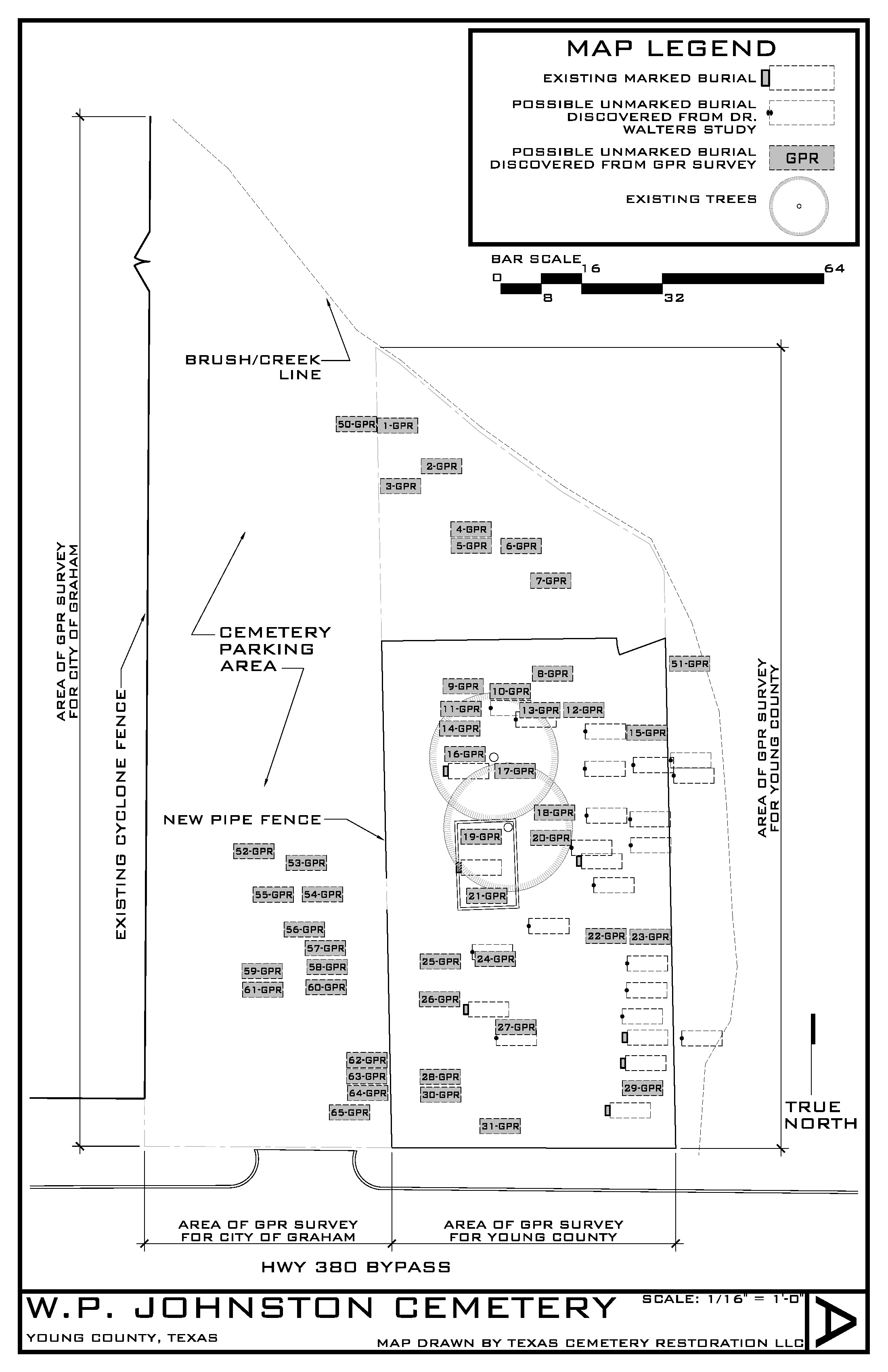
A ground penetrating radar survey of the Oak Grove Colored - William P. Johnston Cemetery and area adjacent to the county cemetery uncovered over 40 possible unmarked graves.
Texas Cemetery Restoration collected GPR data of approximately 0.5 acres at the Young County cemetery located on the Hwy. 380 bypass and the adjacent city of Graham-owned lot. The data uncovered 47 possible unmarked graves within the survey area.
“I’m going to have to get with the city to discuss this further,” County Judge Win Graham said. “I’ve had some discussions with the city manager and the mayor. We’re just trying to figure out what the best and right thing to do is.”
GPR uses electromagnetic radiation in the microwave band of the radio spectrum and detects the reflected signals from subsurface structures. Detections can include objects, changes in material and voids and cracks.
“You’re shooting wavelengths into the ground and it’s bouncing back, but the accuracy is that, so when they’re close, you’re pretty confident on something like that,” Dan Kieninger with TCR said. “You try to use as much technology to make it as exact as possible to get as close as you can. It’s not X-ray, so you don’t see anything that way. It’s just more of an approximation.”
The non-invasive survey can detect buried coffins as well as disturbed soils related to burial activities and possible other remains of the burial such as coffin hardware.
The Young County Commissioners Court approved a GPR cemetery survey with Texas Cemetery Restoration along with a survey of the area behind the cemetery during their meeting Monday, July 14.
Following that survey, the Graham City Council approved a motion Thursday, Aug. 14 to allow the company to expand their GPR survey to the city-owned property to the west of the cemetery currently being used as a parking lot.
A total of 24 “anomalies” were found within the fence line of the cemetery, with some lining up with possible graves found by the team of researchers from Texas Tech University.
“It confirmed a lot of what we were thinking, so in that sense, I feel pretty good about our first phase and how this dovetailed with the GPR research,” said Dr. Tamra Walter, historical archaeologist and associate professor of archeology at Texas Tech University.
While not all of the graves marked using the metal detecting and scraping process from the researchers were in line with the GPR results, Dr. Walter said the findings outside the cemetery matches local reports.
“I think it confirms a lot of what the descendants were telling us. I mean, I always listen to the descendants, but other people are not so sure. But in this case, almost everything they’ve told me has turned out to be true,” she said.
Kieninger noted existing marked graves with GPS to have a base point and a guideline of what to look for in the area. In some areas there is overlap with the previous finding of the Texas Tech research which could be two separate findings or matching findings.
One possible unmarked grave was found to the east of the cemetery and eight were found north of the cemetery in an area where heavy machinery and rocks used to be located.
“There’s some potential grave sites north of our fence line, which obviously, once we get with the city of Graham to figure out a plan they will all be kind of handled together,” Graham said. “But it does look like the fence, at least on county property, will need to be moved further north to accommodate potential grave shafts.”
In the city-owned area currently used as a parking lot for the cemetery, a total of 14 possible unmarked graves were found.
In total, there were 23 possible unmarked graves found outside the boundaries of where the fence line currently stands for the cemetery.
Within the report it stated that due to the high concentration of unmarked burials in a small area the company would recommend having the areas to the east and west be surveyed as well.
Kieninger said GPR cannot be used as the sole measure to determine the presence or absence of unmarked graves, with manual excavation needed to back up the data. Even in soils with good signal penetration, the presence of false negative results are possible.
“In optimal soils, you can get some false positives seeing grave shafts that either somebody dug in the wrong place or somebody got interred, then deinterred and reinterred somewhere else,” Kieninger said. “So it’s an interpretive science… so there’s no 100% exact (answer). The only way for there to be any definitive answers is to actually do an archeological dig and verify.”
Since the beginning of March 2024, Dr. Walter, along with students and the descendant community have worked to unearth the history of the Young County cemetery.
The research team spent three weekends at the cemetery and determined most of those buried in the areas they studied were from Graham and Olney.
Rev. Vanessa Sims first shined a spotlight on the cemetery’s condition. Sims has been working with multiple entities to push for answers for not only herself, but also other descendants.
Sims, who lives in Denton now, was born in Olney and her mother lived in Graham. Her sister Marie Ann East, who was born prematurely in February 1952 and died in the same month, was supposed to be buried in the colored section of Oak Grove Cemetery, but her grave is currently unable to be located.
While using GPR at the cemetery was a goal of the research team, they still are looking to conduct a survey of the Hwy. 380 bypass to determine if there are burials underneath the highway.
Dr. Walter said with the new survey data and a way to move forward, the city and county can help revitalize the cemetery and look past the history of neglect it has faced.
“I’m not saying it was a nefarious intent there, but the neglect definitely led to the loss of that cemetery and almost erasure of it,” she said. “Thank goodness that people paid attention and said, ‘Hey, hold on a second. Let’s do something here.’”