-
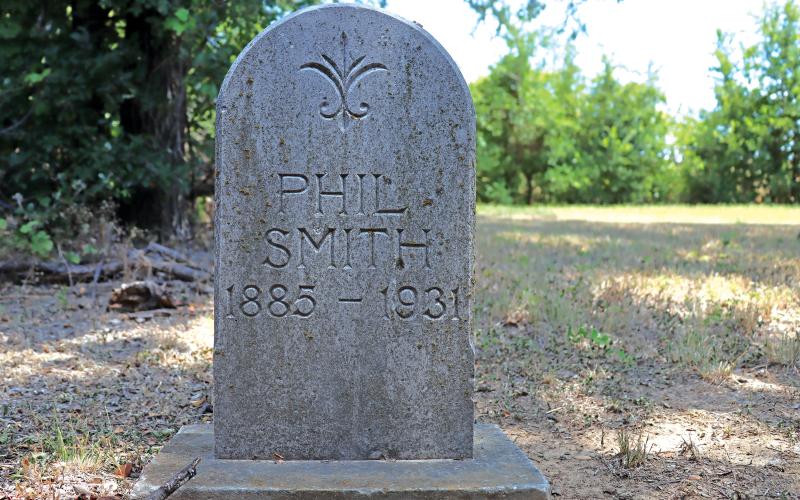 (THOMAS WALLNER | THE GRAHAM LEADER) One of the few standing grave markers in the William P. Johnston Cemetery in Graham which is owned by Young County. The county, with the help of the William P. Johnston Cemetery Preservation Board, are working on steps to uncover the history of the cemetery.
The Young County Commissioners Court received an update this week from the William P. Johnston Cemetery Preservation Board and initiatives moving forward. The court voted to close the cemetery for future burials, recruit new members for the board and plan for surveys of the cemetery.
Young County Judge Win Graham updated the commissioners Monday, Sept. 25 regarding the first William P. Johnston Cemetery Preservation Board meeting. He said the committee came up with a list of goals for the cemetery and divided up tasks among the members.
“Ernie (Jackson) is going to reach out (and) he’s going to help find some additional members for the board and Dorman (Holub) is going to continue research to try to figure out who all is buried in the cemetery,” Graham said.
The board determined that since ownership of the cemetery belongs to the county that they declare it closed and not to accept new burials. Holub said the reason the group suggested the closure was due to the last burial being in the 1960s, according to his research.
“All of those graves were dug by hand and in today’s culture you use a backhoe. Because of the way that cemetery is situated, there is no way we can get a backhoe in there, number one, and number two, because there are so many unknowns in there it’s our fear that if you were to go into that cemetery and start digging, then you might have more issues than we want to get involved with,” Holub said. “Basically, a closed cemetery just means that there will be no more future burials in that cemetery and that it is closed for activity.”
The county judge said the court is looking to in the future conduct two surveys: a survey of the cemetery as it stands today and a survey of what the original cemetery was per the deed. Additionally, the group wants to reach out and find if any interested parties would make the cemetery a college research project.
“We’re going to work on is kind of reach out to archaeology departments across the state of Texas to see if anyone in those departments would like to use that cemetery as a research project for their masters or PhD... and then maybe we can get a... magnetometer to try to find the unmarked graves out there,” Graham said.
Since the Young County Commissioners Court passed the budget for the county before this item was brought to their attention, Graham said the county will have to wait until the next budget cycle to fund items or have the committee raise funding to cover the cost.
“We estimate that surveying the cemetery will cost about $2,500, just based off some other surveys that we’ve done,” he said. “So maybe the preservation committee will have a fundraiser or something to get that done sooner. If not, that’ll be part of the budget that we’ll... request that we build for that cemetery when we do the next budget cycle.”
Background
The county judge was approached in early August regarding county ownership of the cemetery.
At the time, neither the city of Graham or Young County had information regarding the ownership of the cemetery.
“Several investigations of deeds failed to uncover whether the land was owned by the city, the county, or privately owned,” Graham said. “The city, county and local historians all invested time and resources in researching ownership of the cemetery.”
Around Friday, Aug. 18, the document was uncovered which was deeded Dec. 4, 1923 by Addie M. Graham to the county. The deed stated, “that this property shall be used solely as a burying ground for colored people, and should it not be used for that purpose, or if used for any other purpose, this tract shall revert to the grantor, her heirs or assigns.”
Upon discovery of the deed and ownership, Graham researched county and state laws and regulations to see what could be done for the cemetery. The judge said records of those buried within the cemetery do not appear to be complete.
“We know there are tombstones there, but there’s a lot of unknowns that are buried in that cemetery like every cemetery in the county has unknowns,” Holub said. “I think that could be a project maybe (for) somebody working on their masters degree in archaeology, or something to that degree, in the state schools.”
The Young County Commissioners Court had the item on their agenda for discussion Monday, Sept. 11. The commissioners approved an order declaring that the county owns the cemetery.
“It is one of those cemeteries that really needs to be recognized in some ways,” Holub said. “I would say most of the people who are buried in that cemetery are black. There is not really a history on that cemetery that we’ve written. I mean, I’ve done a ton of research on it, but there is just a lot more research that myself and Ernie (Jackson) and those individuals that lived in the Lincoln community will have to do because that is part of our history that needs to be recognized, needs to be honored and needs to memorialized in some way.”
The judge also requested the commissioners set up a preservation committee to serve over the William P. Johnston Memorial Cemetery and report back to the commissioners.