-
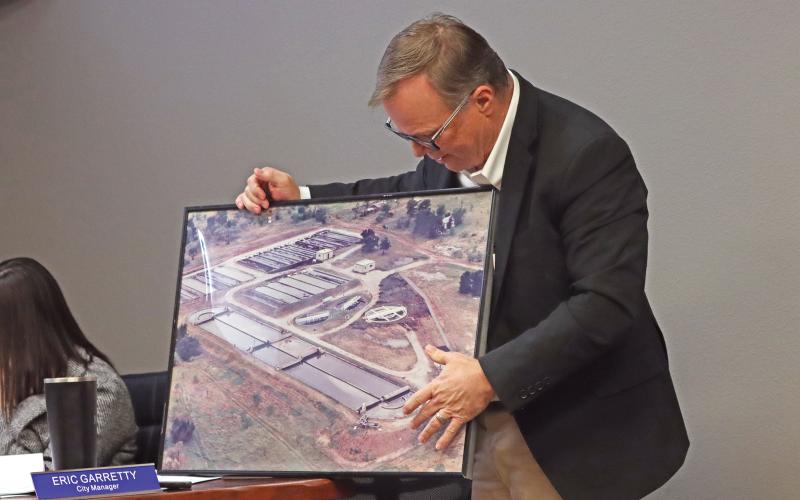 (ARCHIVE PHOTO | THE GRAHAM LEADER) City Manager Eric Garretty shows a photo of a portion of the wastewater treatment plant with the Graham City Council and community Jan. 23, 2025. During that meeting the city approved hiring Freese and Nichols as engineers to plan improvements at the facility.
As the Graham City Council looks to start its budget planning process next week, it will have to consider potential debt options for rehabilitation projects at the wastewater treatment plant.
Nick Landes and John Lopez of Freese and Nichols presented a preliminary design report and option of probable construction costs for the wastewater treatment plant rehabilitation project during the city council meeting Thursday, Feb. 5.
Two phases were presented to the city council, with the first estimated to be bid in 2028 and the second to be bid in 2030. The total cost of both phases is estimated at $35.8 million.
Phase 1 is estimated to be a total cost of $19,260,000 with the largest items being electrical and power signal distribution at $5.37 million, construction of an administration and electrical building at $3.2 million, construction of an ultraviolet (UV) disinfection facility at $1.5 million and Return-Activated Sludge and Waste Activated Sludge improvements at $1.44 million.
“(Phase 1) improvements, they’re really important, really critical, but it still takes a long time to construct. So getting electrical infrastructure, there’s long lead times on that electrical gear, and so we’d expect that to be online close to the end of 2029,” Landes said.
The company examined three areas when evaluating the system which were condition and maintainability, capacity and compliance and safety.
The city’s wastewater treatment plant was built in 1978, with age impacting a number of components.
“Mechanical equipment, just like you would expect with a car or anything that’s mechanical in nature, it’s going to have a lifespan. It’s not going to go forever. It’s going to need significant maintenance and sometimes, whenever things get old, the maintainability of them goes down because the parts aren’t as available as they once were,” Landes said.
Landes said the electrical infrastructure is on “borrowed time” and must be addressed.
“The panels, lots of them, are original from 1978. They’re old and outdated. It’s obviously the pulse of the plant,” Landes said. “The power comes in and if the power doesn’t get out, none of it matters. The compliance is out the door, the safety is out the door and the facility is not working and it’s going to be a major issue.”
The engineer recommended a combined administration and electrical building to get the electrical infrastructure in an air-conditioned, controlled environment that could last for 20-plus years.
The duct banks which house the wires moving from place to place are in poor condition and showing wear. Many of the duct banks in the facility are original from 1978 and would need to be moved if a new facility is constructed.
“Repurposing or reusing the existing duct banks is very difficult and would probably be cost prohibitive, but it also presents a significant risk to the contractors and the contractors will ask a premium for that,” Landes said.
The existing wastewater treatment facility used chlorine gas, or mustard gas, to treat the water but poses a number of risks.
“It’s used at many facilities, but it poses inherent risks and dangers, not just to the operators that are on site, but also to the citizens,” Landes said. “These containers have to come through town and then, once they get to the facility, if there’s a leak at the facility, it would affect the surrounding folks. So it’s a dangerous chemical, and we propose that you move away from that.”
Garretty said the design portion of Phase 1 will take approximately one year.
Phase 2 is estimated to be a total cost of $16,580,000 with the largest items being the secondary clarified mechanism replacement at $4.96 million, the electrical power and signal distribution at $2.47 million and the replacement of the oxidation ditch aeration system at $2.17 million.
A recommendation under this phase is to replace the existing aeration equipment that is in a failing condition and provide a maintainable aeration system sufficient for compliance.
“They’re farming bacteria, harvesting bacteria and they need to have a certain population of bacteria to do it. For those bacteria to thrive, you have to get air into the water. Right now, what is getting air into the water is these brush aerators. They’re very old technology. They’re very inefficient. They’re extremely difficult to maintain,” Landes said.
The second recommendation in Phase 2 is a rehabilitation of the secondary clarifier. Two of the three clarifiers were built in 1978 and the third was built in 1989.
“These particular facilities, they take the bacteria and they make sure the bacteria stay in the process. They settle the bacteria out so that it doesn’t get into the creek. They’re critical infrastructure, and the mechanisms are about 15 years past their typical useful life,” Landes said. “...The concrete is good. We just need to replace the interior, the structural steel components of it.”
The city is permitted to treat up to 2.1 million gallons of wastewater each day, with the average being 600,000 per day. The proposed improvements will not add to that permitted capacity at the facility.
“We’ve also looked at flow projections and population projections, and there’s no need to go beyond that. You’ll be able to maintain that 2.1 million gallon per day capacity,” Landes said.
The city council previously received a report at the beginning of January from Senior Managing Director of Hilltop Securities Jason Hughes, the financial advisor hired by the city. Hughes provided debt options available for both the wastewater treatment plant and a replacement fire truck.
“We’re talking about what’s probably going to be an eight year journey, and there are a lot of elements up front in the pre-design, in the debt financing,” City Manager Eric Garretty said Jan. 8. “There are elements you need to get right and so we’re proceeding very deliberately.”
Garretty said Thursday the city does not want to borrow $36 million and cause a large impact on the ratepayers. He said another approach would be to borrow money over time.
“We can reasonably borrow the total amount over time and phase it in and get it done, which will minimize the impact on the customers of our system,” Garretty said. “Now, having said that, ...we’re going to get into a period where customers are going to see their sewer bill going up every year. But in order to get this done, we’re trying to put that in increments, so it’s not a big shock to everyone upfront.”
The city manager suggested an ask of the community to borrow $8-10 million for the first phase which would provide a contingency plan in case something crucial fails at the wastewater plant.
“The first part of that is going to go really slow. …We’re going to make sure we get it right. But in that interim period, say, over the next two years, if we had that cash available, and if something begins to fail, we have a whole engineering team right on board, you have your public works team and we have the funds available,” Garretty said.
On the agenda for the budget meeting to be held Tuesday, Feb. 17, is consideration to direct the city's financial advisor and bond counsel to draft a notice of intent to issue Certificates of Obligation in an amount not to exceed $14.6 million.
This amount would be in support of the wastewater treatment plant rehabilitation and the acquisition of a new fire truck for Graham Fire Department.