-
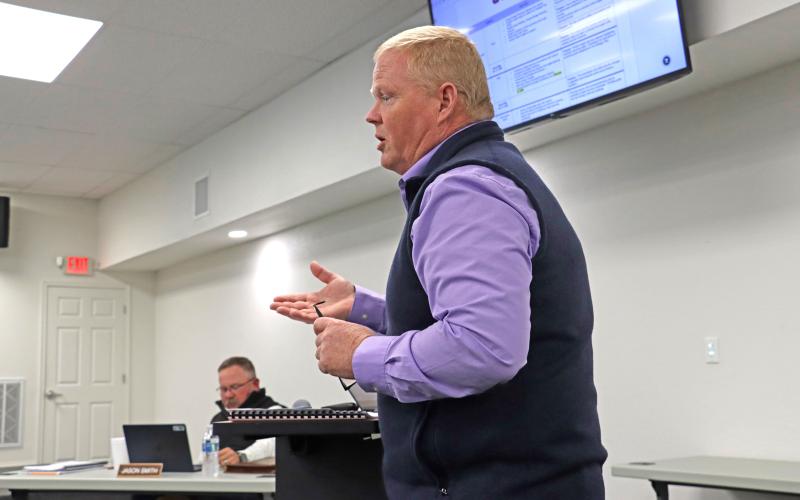 (THOMAS WALLNER | THE GRAHAM LEADER) Graham ISD Chief Financial Officer Gary Browning speaks with the GISD Board of Trustees during their meeting held Wednesday, March 4 regarding the upcoming 2026-2027 budget.
The planning process for the Graham ISD budget is underway, with the district planning earlier after a permanent shift in the fiscal year from September to July made last year.
During last year’s budget planning, the district was looking at options to improve its financial standing. One method was to change the fiscal year from Sept. 1 through Aug. 31 to July 1 through June 30.
Chief Financial Officer Gary Browning said the move would allow the district to plan its spending throughout the summer for the upcoming fiscal year. The move was approved by the GISD Board of Trustees during their meeting Oct. 8, 2025.
Browning presented to the board Wednesday, March 4 what has been completed so far with the budget planning process and what is in store for the future.
“It’s important that we understand and that we see that the budget planning timeline will change based on this fiscal year, and how that will impact our activities leading up to the adoption of the budget,” Browning said.
In January, the district reviewed its budget planning calendar, prioritized its needs based on the GISD Strategic Plan, included student projections for the upcoming school year and began analyzing the district’s budget by program.
“We looked at student projections, student numbers for the year. On top of that, we’ve also, since that time, received our demographers report and that added to our student projections for the future,” he said. “We also reviewed staff and student ratios at each grade level and within each program to see what programs may need to be streamlined and where our staff needs to be placed to be most effective and meet our students’ needs.”
In February, the district had preliminary budget discussions with campus principals and program directors and provided them with a budget planning worksheet and calendar.
“Each campus and department, we are able to break out their budget lines for just their department so they can see those individually. We provide that to them,” Browning said. “We also provide what their current fiscal activity has been to date, so they can see where they’re spending their money, how much is left leading up to these last few months of the fiscal year.”
The district CFO said that the current fiscal activity report given to those employees can help them consider their expenditures from last year in each budget item and see if changes are required.
The campus and department budget worksheets were due in February, but that deadline has been extended so that the district can meet a second time with those employees to make sure those are finalized.
“After we get back from Spring Break, hopefully all of our budget worksheets will be finished so that we can start to put our budget together over the next two or three months,” Browning said.
The district will review the employee compensation plan this month for presentation at the school board during a budget workshop Wednesday, April 25. During that workshop, the school board will discuss the compensation plan and receive a budget overview from Browning.
Browning said as far as there are preliminary state funding projections that are not including new legislative actions. In April, the district will calculate its Maintenance and Operations (M&O) and Interest and Sinking (I&S) tax rates.
“Those are the two tax rates that determine the tax levy from the local property taxes. Because those will not be certified fully by the appraisal district at that time or even through probably June, we will be developing our budget based on projected tax rates,” Browning said.
The board will receive a proposed budget in June based on projections with those tax rates and during that same month they will develop the final budget.
“In July, we’ll come back and we’ll have our tax rates set in stone, and we’ll review that compared to what we projected, and we’ll either decide to amend the budget or keep it the same because we were close enough on our projections,” Browning said. “That is really the largest challenge of starting this fiscal year in July, 1 is that we won’t be set on exactly what our property value revenues will be as well as our tax rates.”
Browning said the fiscal year change has backed up most of the budget planning activities by two months from their usual timeline and that the order of process could be changed based on the availability of information.
“We won’t receive our maximum compressed rate from TEA until July, and that’s after our budget year starts. So once we receive that rate, we add five cents to it, (and) that becomes our M&O rate. The I&S rate for bond and repayment is something we can deal with and predict,” he said. “The challenge moving forward with the I&S tax rate is that the state is starting to limit districts on what they can set based on what their debt is.”
The budget planning process under the new fiscal year will continue for the district and school board as they work to establish their 2026-2027 budget before July. A board workshop will be held Wednesday, March 25.
“As we work towards the end of June, know that the budget that we adopt at that time may change a little bit based on what we get back from the state, on our M&O tax rate. I hope that we’ll be close enough where we don’t have to make a change or amend our budget, but that could happen at that time,” Browning said.