-
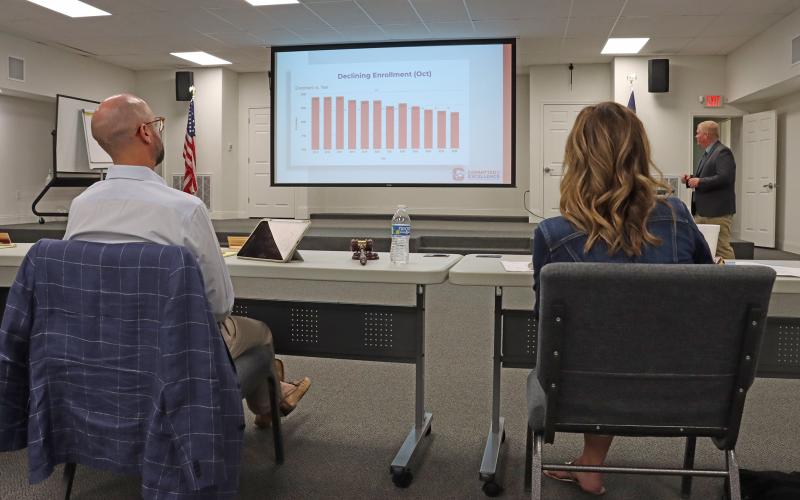 (THOMAS WALLNER | THE GRAHAM LEADER) Graham ISD Board President Chris Blanton (left) and board member Lauren Mahaney listen to a budget presentation Wednesday, Aug. 6 from Chief Financial Officer Gary Browning. A public hearing will be held Wednesday, Aug. 27 for the budget and tax rate.
 -
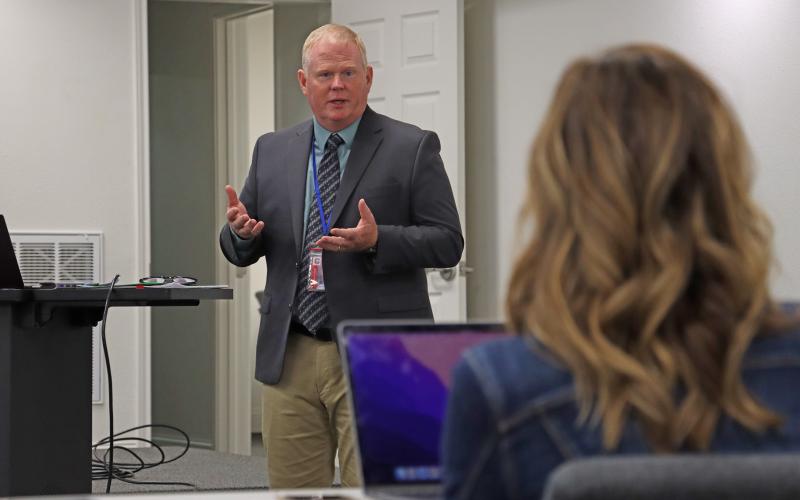 (THOMAS WALLNER | THE GRAHAM LEADER) Chief Financial Officer Gary Browning speaks to the Graham ISD Board of Trustees during a budget discussion Wednesday, Aug. 6. The board will consider adoption of the budget and tax rate following a public hearing Wednesday, Aug. 27.
A public hearing for the Graham ISD budget and tax rate is approaching next week as the district works to refine its numbers and is proposing a tax rate just under the current rate.
The board will vote to adopt the budget and tax rate during their meeting scheduled for 8 a.m. Wednesday, Aug. 27 at the GISD Administration Building at 400 Third St.
Chief Financial Officer Gary Browning spoke to the GISD Board of Trustees during meetings held Wednesday, Aug. 6 and Tuesday, Aug. 12. Browning explained the importance of the district to not overproject its revenue and underproject expenses.
“Inflationary costs on the maintenance and operations side over the last five years skyrocketed, and our budgeted expenditure lines for those costs have not been increasing at the same rate,” he said.
Additionally, Browning said the current year local tax collections were underestimated, but will be made up by state revenue which is in excess of projections.
The district is proposing the voter-approval rate of $0.9863 per $100 valuation, which is a slight decrease from the current tax rate of $0.9888 per $100 valuation. The voter approval rate is the highest tax rate the district may adopt without holding an election to seek voter approval of the rate.
“We don’t have a lot of flexibility within setting these rates. The state provides the maximum compress rate then we can adopt, and then we can adopt five pennies on top of that, without going to the voters for approval of a further increase,” Browning said. “The appraisal district has had a big part in the calculation of this rate.”
The fund balance for the district has dropped from $22,465,694.90 in December 2023 to $16,231,429.09 in June 2025, with the largest drop from 2024 to 2025 of $4.73 million. As that fund decreases, the interest for that fund has also dropped.
“The things you have accomplished with (the most recent funding) are turf for softball and baseball. You’ve also accomplished the band hall at Graham Junior High and several other smaller projects as well,” Browning said. “A lot has been accomplished with that money, but we also need to be aware that the fund balance is declining and decreasing as we move forward.”
As of the meeting last week, the school was projecting a loss of $1,091,917 for the coming school year between their funds, but are working to adjust that number.
“Between now and the next meeting (Aug. 27), I’m going to continue to review our expenditures and our revenues to see if there are areas we can work to improve this situation,” Browning said.
The district is also looking to move money within the current budget so it will not have to pull fund balance money to make this year’s budget.
“We budgeted $23.9 (million in the fund balance last year). We brought in $22 (million) so the revenue is short there. However, we have an August payment from the state that will come to... at just over $2 million that will cover that amount and put us in the positive about $135,000,” Browning said.
One challenge the district is facing with the budget are declining enrollment and attendance rates, which was discussed during both budget meetings.
Since 2015, with the exception of 2022, the district has seen a decline in enrollment, with 2,445 in October 2015 and now 2,122 anticipated for 2026.
“A major factor in funding from the state is enrollment and attendance. And so have to be aware that our numbers may not be quite what they were this year next year if the trend continues,” Browning said.
Trying to improve attendance is part of the strategic plan and the district is in communication with campuses to track newly enrolled students in regards to those being from neighboring school districts or private schools.
“What we are planning on doing in the future is asking our parents (that exit the district) if they intend to return. That would be a practice that we would want to add into our practices in Graham,” Superintendent Mary Johnston said.
A general education student who receives no additional special services will provide the district $35 per day from the state.
“A student who does receive special services can help us with funding up to $55 per day,” Browning said. “...Loss of one student in enrollment costs GISD between $6,380 and $10,000 in the school year. So 30 students would equate to between $191,400 and $300,000.”
The amount budgeted for wind farm revenue last year was over $1.2 million while the actual revenue brought into the district was $753,649. Upon consulting the district’s contractors for the wind farm investments, they estimated the district could expect $226,000 in revenue this year.
While some of that drop is based on the anticipated depreciation over time, it also included a supplemental payment that will no longer be provided to the district.
“We received a supplemental payment from the previous year in the amount of about $500,000 so that’s why that amount looks so much more inflated,” Browning said. “It’s not all depreciation from one year to the next. …So that is decreased revenue for us in this coming school year.”
One area of the budget that is a recurring negative in revenues over expenses is in athletics. In the proposed budget for GISD, a loss of $412,120 is anticipated with $150,000 in revenues and $562,120 in expenditures.
“They bring in revenue through game receipts and so on,” Browning said. “They would never bring in enough revenue to support the program completely across the board. So that’s why there is a negative difference there, and the General Fund has to complement or supplement that each year.”
One change within the budget is staff compensation which includes House Bill 2 funding from the state with a $4,000 raise for teachers with 3-4 years experience and $8,000 for teachers with five or more years experience.
On top of the state-funded raises, a district-funded $2,000 raise for teachers with zero to two years experience was added.
Additionally, raises of 3% from the market midpoint were approved for auxiliary staff, instructional aides, clerical staff, counselors, special programs and administrators.
“The administrative staff is included with the teacher raises because the motivation to be an administrator decreases tremendously if you can make more being a teacher, and that would be the case if you didn’t make some adjustments to administrative staff salaries there,” Browning said.