-
 (THOMAS WALLNER | THE GRAHAM LEADER) Graham ISD Business Manager Don Davis held a budget workshop with the GISD Board of Trustees during their meeting Wednesday, Aug. 14. Following the workshop, the board approved the proposed budget and tax rate.
 -
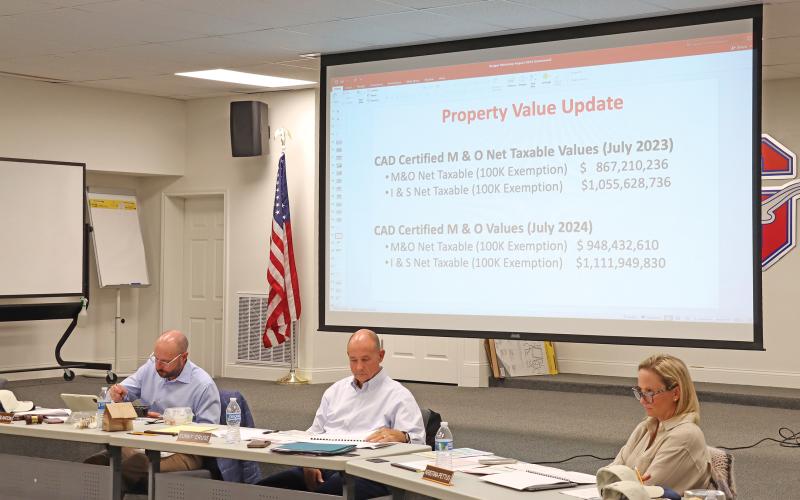 (THOMAS WALLNER | THE GRAHAM LEADER) The Graham ISD Board of Trustees listened to a budget presentation during their meeting Wednesday, Aug. 14. The board approved the proposed budget, but requested the budget be balanced before adoption Wednesday, Aug. 28. Shown from left to right are Chris Blanton, Sonny Cruse and Kristina Pettus.
With a goal of balancing the budget before final adoption, the Graham ISD Board of Trustees last week adopted a proposed deficit budget and a lowered tax rate.
With anticipated revenues on the way, the board adopted the proposed deficit budget with a request to amend the budget to be balanced with those added revenues.
The proposed budget has $27,507,785 in revenues and $28,865,210 in expenditures, or a difference of $1,357,425. Expenses increased $1,385,325 in the general fund, $72,130 in the athletic fund and $71,970 in the food service fund.
GISD Business Manager Don Davis gave a presentation Wednesday, Aug. 14 regarding the budget and explained why the deficit was proposed. He said the district will receive a second payment of $1.1 million from the Senate Wind farm project, in addition to $219,000 payments over 10 years.
“So the $1.1 (million) is going to be realized next year (in January), in addition to any other... revenues, for example, delinquent taxes, I think that was over $100,000,” Davis said. “So what that means at the end of next year, unless the board chooses to spend additional money, it should be a balanced budget.”
The district had $3,009,807 in revenue over what they budgeted for 2023, but also had $5,599,311 in expenditures over what was budgeted. In total, the district is $2,589,504 over what was budgeted for 2023 and that funding has been budgeted from the fund balance.
“I'm projecting that... we're going to reduce the fund balance by about $2.6 million,” Davis said.
That follows a trend that also extended to tax collections and state funding for 2023, which were under what was budgeted.
“I had budgeted for tax collection... $6.291 (million and) we collected $355,000 less. In state funding we collected $152,000 less than what I budgeted. So that's the example of... what we're going to receive could be less,” Davis said. “...I know that we have some outstanding collections. We're probably going to collect those. They may be delinquent. And we don't know that about the appeals yet, because we're budgeting on without knowing the appeals they're going to be approved, and there's a lot of appeals out there.”
Superintendent Sonny Cruse said a deficit budget can make the board start thinking about future planning.
“Unless we get increased enrollment, unless we improve attendance, unless the state funding formula changes, there's going to come a time where you cannot take money out of fund balance. By doing the deficit budget, I think that keeps it in front of your mind,” he said. “...You’ve got to think, 'Oh, we've got to be cautious. We've got to be thinking about overstaffing,' because, as you've well seen, almost all these budgets, the good portion of all these functions are staff salaries. So the only way to really reduce a budget in the future is to have less people.”
The district did not budget for a “ghost fund” this year which is a reserve in case they have to hire additional staff. If that is required, the board will have to pass a budget amendment.
In the proposed budget, the instruction line item is increasing from $13,324,571 to $14,240,709. That line item has categories for salaries, supplies, travel and contract services.
“The biggest increases (in the budget) are in additional staff and raises and that accounts for... $2 million. We were using ESSER (Elementary and Secondary School Emergency Relief) money to pay for some reading interventionists and mentors. We were using it for two half-time diagnosticians, and they were on contracted services, and we are moving them over into the budget. And then the curriculum money that was used in ESSER was for NWEA math and Eduphoria. So those are the increases in ESSER that we've absorbed,”
Salaries in the instruction portion of the budget make up $13,300,000 of the $14,240,709 proposed in the budget.
Members of the board requested that the budget be balanced before it is presented for adoption, but Davis said some of his estimates could fall under what he proposed.
“The revenues that I put in state funding could be less, because if enrollment goes down, then those could be less, and we're trending down,” he said. “So... just to be cautious I budgeted on the same number of refined ADA (Average Daily Attendance), but if that goes down, then the revenue will go down.”
Unlike enrollment, the refined ADA is the number of students counted each day within a 15-20 minute period and determines the state funding received by the district.
Student enrollment since 2013 has trended downward from 2,552 in 2013 to 2,175 in 2024, with occasional increases year over year. Refined ADA also is showing a downward trend from 2014, with 2,378 in 2014 and 1,996 in 2024, with occasional increases year over year.
GISD proposed a tax rate of $0.9888 per $100 valuation, which is a little over a three-and-a-half cent drop from the current tax rate of $1.0239 per $100 valuation. The tax rate is made up of two separate rates: the maintenance and operations (M&O) rate and interest and sinking (I&S) rate, or the debt rate.
“(For the M&O rate) the state has a formula that it takes your prior year certified values and your current year values, and if you have growth, then that growth is going to drop your tax rate and the tax rate that it drops it to should equal a levy that would gain you equal taxes from the prior year,” Davis said.
The district has in the past redeemed their bond payment early and will continue that trend for the upcoming year. The district will be redeeming a bond payment of $1.49 million which is beneficial because it will not increase the I&S tax rate above the current $0.3106.
“We're paying off interest faster by doing this. We're lowering the tax rate three-and-a-half cents. We're paying off the bond faster. We're lowering the interest we're paying on the bond, while keeping the 31-cent capacity for the future bond,” Davis said.
The NCTC tax rate approved for $0.042367 per $100 valuation, which is an increase over the current rate of $0.040390 per $100 valuation.
“The reason why the district annually approves the proposed tax rate for them is because the district was the entity that proposed the tax election. So it rests within our governing body's jurisdiction,” Cruse said.
A public hearing on the GISD budget and tax rate will be held at 7:45 a.m. Wednesday, Aug. 28 at the GISD administration office at 400 Third St.