-
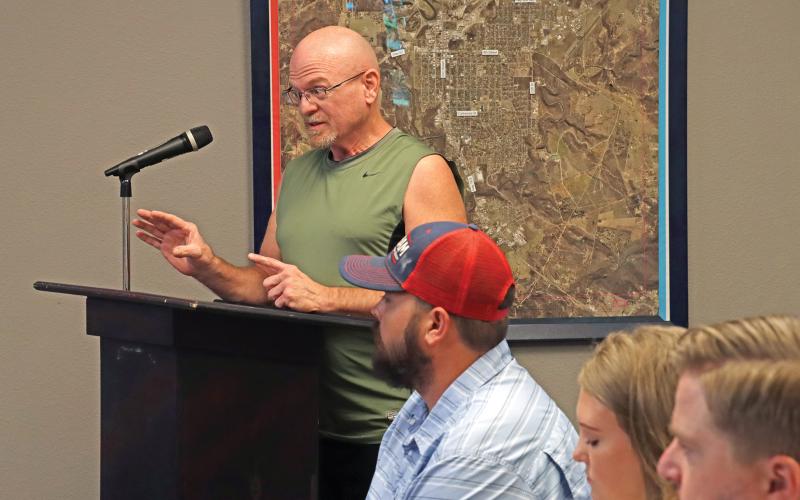 (THOMAS WALLNER | THE GRAHAM LEADER) Greg Bonzelaar speaks at the public hearing Thursday, Aug. 15 regarding the increases to sewer connection charges, water tapping fees and wastewater and water service charges. Bonzelaar had concerns about the cost for retaining engineering services.
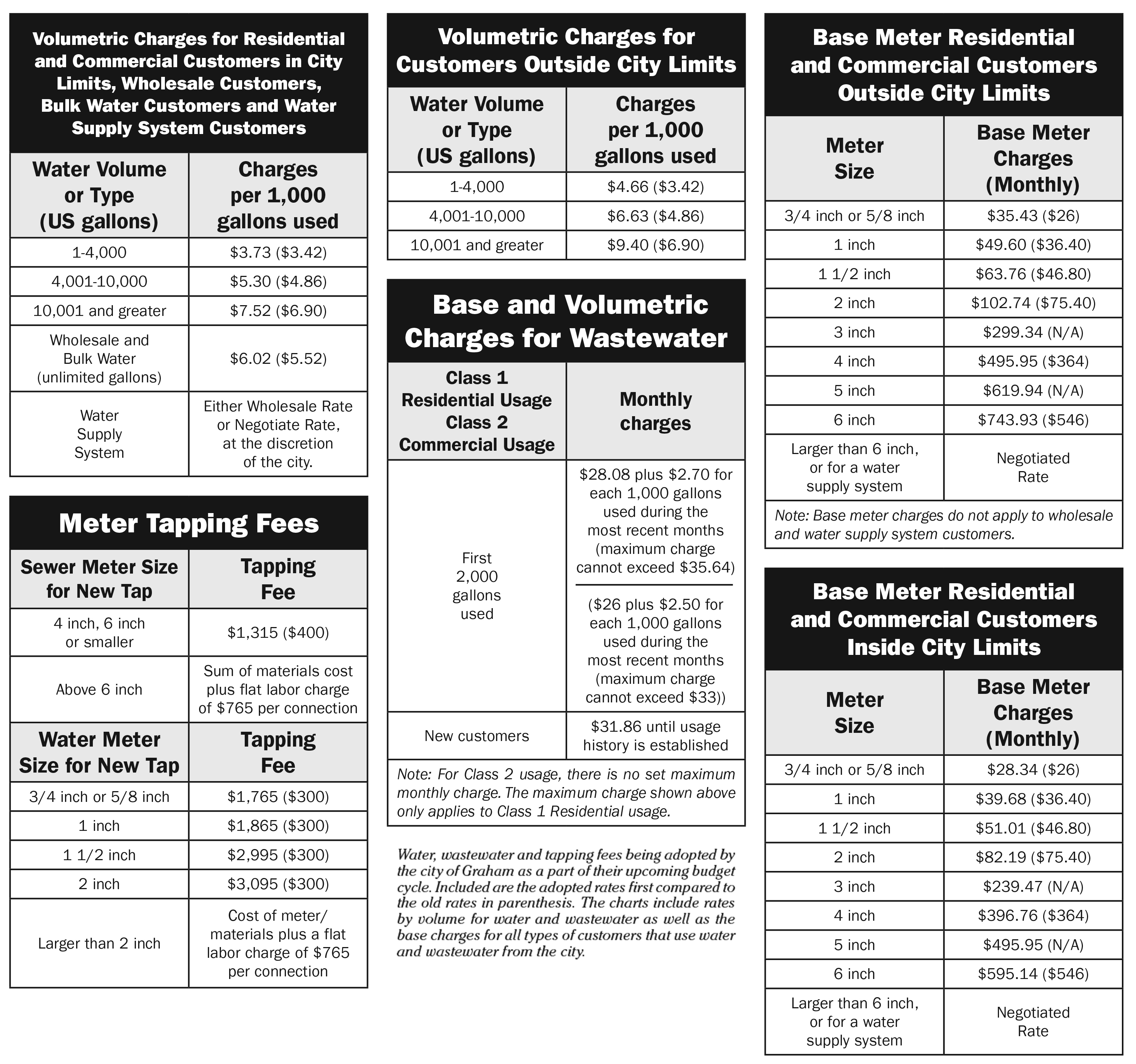
Increases in sewer connection charges, water tapping fees and wastewater and water service charges are on the way following approval by the Graham City Council last week.
The adopted increases will not immediately be enacted, but will take effect with the billing period beginning Thursday, Oct. 15. City residents will see an increase to payments on water bills in November for usage in October.
City Manager Eric Garretty gave a presentation on the new rates before the Graham City Council meeting Thursday, Aug. 15.
“The cost to produce and distribute potable water throughout our system continues to increase due to increased operating costs, for example, costs of chemicals, costs of replacement equipment (and) costs of pipeline maintenance,” he said. “These costs are in addition to increasing demand for capital improvements to replace or rehabilitate water distribution system infrastructure.”
The city water and sewer funds are self-sustaining, meaning they are supported by the fees charged to city customers.
From 2022 to 2023, the city manager performed a financial analysis of the city’s rate needs for the water and sewer systems which found the current rates were not sufficient revenue to maintain and sustain both the water and sewer departments.
“The city’s water and sewer systems have experienced significant inflationary quick pressures during the 2017 to 2024 period. The reason that (2017) period is significant is that’s the last time the city has touched the water side of the rates,” Garretty said. “For example, the cost of chemicals for treatment have increased by 20-40% over that seven year period since those rates were last adjusted. It costs us more to produce a gallon of water in 2024 than it did in 2017, that’s the bottom line.”
The city council ordered a water and sewer rate study and received the final report Thursday, June 20 from Willdan Financial Services.
The city was presented two five-year rate plans with increases each year and approved the first scenario.
“Generally, for inside the city customers, the rates of water and sewer charges together will increase about 9%,” Garretty said. “Outside the city rates have been established. The outside the city rates will see a 36% increase from current rates. The reason for this is in the current ordinance is council opted to have a 25% premium on those water customers who reside outside the city.”
Garretty said water and sewer customers should expect smaller rate increases over the next five years.
“What’s driving that is if pricing inflation continues to bear on water and sewer operating costs, these pricing increases must be covered by increases to the rate,” Garretty said. “...Water and sewer systems must pay for themselves. The need for revenue to support infrastructure replacement will likely increase over this period. Nobody in this (council) room knows when the next water line is going to fail, and we have to take positive steps to be able to respond to that and keep the water distribution system (operational).”
The aging water and sewer infrastructure within the city has made many projects necessary such as the replacement of the water storage tanks which will be covered for $500,000 a year for three years.
The city manager said the projects are not exclusive to the water treatment and distribution side.
“The city must undertake a major rehabilitation of the sewer plant in the next two to three years,” he said. “...There has not been a major rehabilitation to the sewer plant in the period between 1980 and 2024. ...We’ve got to do something, and we’ve got to do something now.”
Resident Greg Bonzelaar asked the council about the $530,000 engineering cost estimated in the budget for the sewer treatment plant.
“There’s another study to replace the wastewater treatment plant, and that’s what the engineering cost is for,” City Council Member Jeff Dickinson said. “It’s not on the rehab of any of the storage buildings, it’s an actual future project that we’re looking at. So we’re engaging those engineers to do that study on the cost of and replacement of the wastewater treatment plant. ...And unfortunately, that’s what those guys charge because we had proposals for that and looked at their costs.”
The city manager said there is funding available from the state that the city could qualify for, but one of the requirements to be eligible is the engineering study.
Part of the engineering study involves the chosen firm submitting a report to the Texas Commission on Environmental Quality (TCEQ).
“TCEQ, I’m anticipating... they’re going to tell us… our wastewater treatment master plan is out of date. That’s a fairly significant document that requires consultants to update because TCEQ requires specific elements,” Garretty said. “That wastewater treatment plan update becomes very expensive. ...I’m anticipating we’re going to have to do that. The reason that we spend that money is to make sure that when I come back to the council with options, we’ve done the steps necessary to apply under any of those programs. That’s part of what’s driving that cost up and gives you that ($530,000) price.”
During the meeting Thursday, the city manager showed a picture of a water pump at the Woodland water pump station with flanges that are used to create water pressure and deliver water. The flanges were greatly reduced in size due to wear.
The public works director said the pump is at the end of its service life and the department has attempted to keep it serviceable for those who need it.
“The cost estimate to repair this pump is $26,550 with an estimated lead time to repair it for 14 weeks. That’s one pump out of well over 15 that we have in the system. Repair costs of $26,000 (are) not insubstantial. In 2024, the cost to buy a brand new pump is $29,000 (with a) $3,000 difference between repairing and buying new,” Garretty said. “...I realize this is just one item, but what I want to highlight to the council and the public is we’re behind on updating, improving and maintaining our water infrastructure, and that costs money, and that’s part of what’s driving the need for these rate increases.”
The city has budgeted $6.46 million in the water fund and $1.65 million in the sewer fund for the upcoming fiscal year and the city manager said the approved increases will be crucial to meeting those estimates.
“The increase is needed to cover the city’s actual cost for operating and recapitalizing the city’s water and sewer systems,” Garretty said.