-
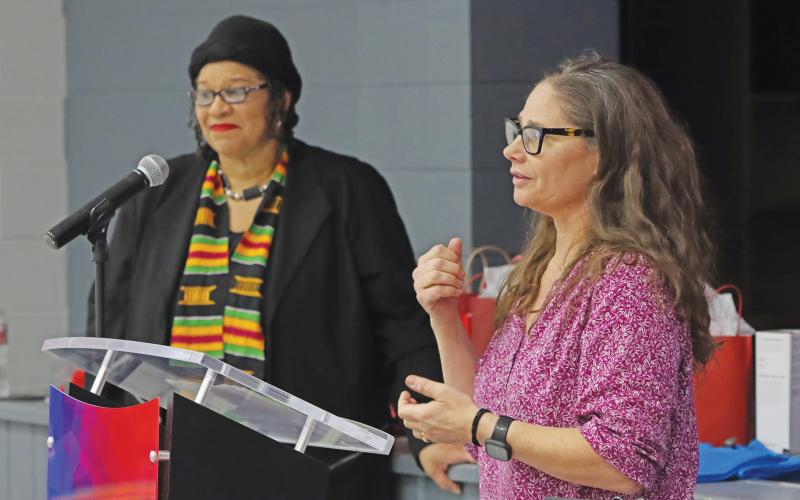 (THOMAS WALLNER | THE GRAHAM LEADER) Dr. Tamra Walter, a historical archaeologist and associate professor of archeology at Texas Tech University, gives an update on research of a the Oak Grove Colored - William P. Johnston Cemetery.
 -
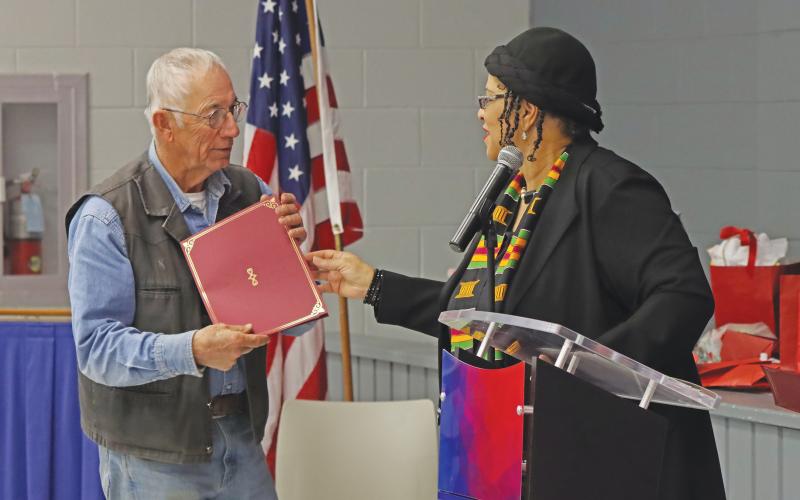 (THOMAS WALLNER | THE GRAHAM LEADER) Rev. Vanessa Sims hands a certificate Saturday, Feb. 15 to John Bullock for his contributions to the Oak Grove Colored - William P. Johnston Cemetery research project.
Saturday was a celebration of the work completed and underway at the Oak Grove Colored - William P. Johnston Cemetery and the efforts to uncover the history that lies beneath its soil.
Since the beginning of March 2024, Dr. Tamra Walter, a historical archaeologist and associate professor of archeology at Texas Tech University, along with students and the descendant community have worked to unearth the history of the Young County cemetery.
The team was selected to receive the third place Mark E. Mack Community Engagement Award from the Society for Historical Archaeology. The award was presented at the Conference on Historical and Underwater Archaeology in New Orleans, Louisiana in January.
“SHA is actually an international society, so we have scholars from all over the world that are members of the SHA. So it really was an honor for us to receive this award, but we couldn’t have done that without all of you, all the people that supported us, not just our archeology team, but obviously Vanessa, the descendants and the greater community of Graham that provided services for us and support,” Walter said.
Rev. Vanessa Sims first shined a spotlight on the cemetery’s condition. Sims has been working with multiple entities to push for answers for not only herself, but also other descendants.
Sims, who lives in Denton now, was born in Olney and her mother lived in Graham. Her sister Marie Ann East, who was born prematurely in February 1952 and died in the same month, was supposed to be buried in the colored section of Oak Grove Cemetery, but her grave is currently unable to be located.
“Dr. Walter and I met Sept. 18, 2023, and we have been on this journey for almost two years. And it hasn’t been an easy journey, but we’re still here,” Sims said. “...The reason I came to Graham was my father died, and I came to his memorial and I realized that I had not made proper honor to my sister Marie. And so I promised to myself that I would come back to try to find her and honor her grave.”
Sims invited her 91-year-old mother to the ceremony Saturday, Feb. 15 and said they are trying to locate Marie’s grave before she passes away.
“She’s a cancer survivor. When I started seminary, the doctors gave her 18 months to live in 2013, (and) she’s still here. So I praise God for that. So that’s what keeps me going, keeps me on this journey trying to find her grave,” Sims said.
Those who have assisted with the cemetery work were honored during the ceremony Saturday.
The city of Graham also read a proclamation Thursday, Feb. 13 recognizing Black History Month in February and recognizing the designation of the cemetery as Historic Texas Cemetery by the Texas Historical Commission.
What comes next for the research?
Phase one of the research project was a student graduate course with a focus on the cemetery. The group spent three weekends at the cemetery and determined most of those buried in the areas they studied were from Graham and Olney.
Walter gave an update on the project during the ceremony and said after connecting with scholars at the awards ceremony in New Orleans, she was able to connect with the Texas Department of Transportation Cultural Resources Director Rebekah Dobrasko.
Walter said she had previously spoken with Dobrasko who was later at the ceremony and saw the team’s research findings.
“When we made our findings public at the SHA conference, we had the poster... that shows exactly what happened with the boundaries of the cemetery over time, and clearly showing that it had been paved over,” Walter said. “I sent her a copy of the report that we produced this summer. We are working currently with (TxDOT) to have a ground penetrating radar survey done, which we think that the highway department will do.”
The professor said the ground penetrating radar will allow them to use remote sensing equipment to determine if there are burials underneath the Hwy. 380 bypass. The next step after that survey would be up to the descendant community which would have to speak with TxDOT.
The research group will also return in the spring with volunteers to investigate the back area of the cemetery outside its current boundaries.
“There is a gravel bed that was laid down. We need to have that pulled up so we can metal detect. That was one of the ways we were able to find the temporary (grave) markers,” Walter said. “There’s a lot of metal and trash, basically, that’s laying in the back that needs to be removed first.”
Walter said one of the stories the group heard was regarding workers finding three remains of bodies which were placed into a wooden box and buried in the back of the cemetery.
“The last time we were here, we were using the Auger to do some phosphate analysis, which is a soil chemical analysis that helps you determine whether or not you have soil where a burial is, because a burial would change the phosphate in the soil. ...They were taking very small samples, and they weren’t going that deep. ...Well, lo and behold, they hit some milled wood with some nails,” she said.
The group has also been invited to the conference in March with legal scholars to see how they can address deeds and ownership and other legal concerns that occur when they do these research projects.
“We have been collaborating with this group, and we’re looking forward to that... happening in March,” Walter said. “We’ll be attending that conference in Lexington, Kentucky, and hopefully learning more about how legal resources can be used to help a lot of these marginalized communities and cemeteries that are at risk.”
Sims was thankful the project was still going strong and that the community has been understanding regarding her drive to see it through.
“It’s all about the community coming together doing God’s work. And I thank you for trusting me and allowing me to nudge you, push you and just do what I do,” she said. “My family knows me and they just let me do what I do, especially when I say God called me to this work, but God called the community together to do this work together, and we have developed so many partners along the way.”