-
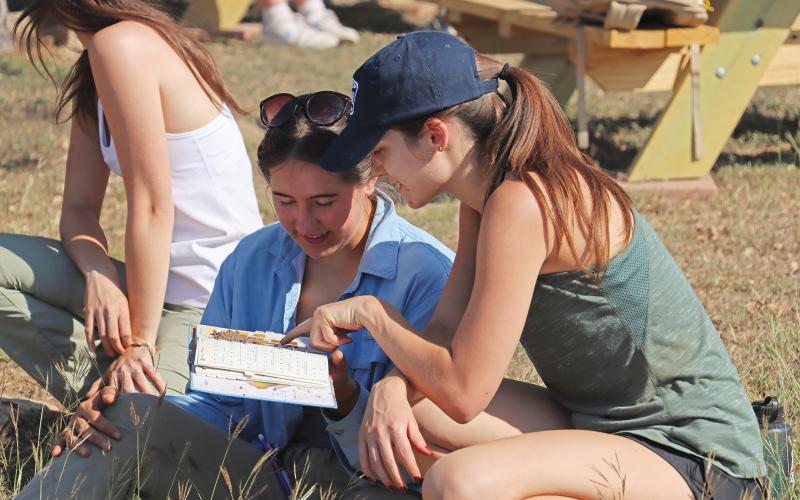 (THOMAS WALLNER | THE GRAHAM LEADER) Anna DesHotels and Abby Sink examine soil samples Saturday, Oct. 12 collected from the Oak Grove Colored-William P. Johnston Memorial Cemetery.
The efforts of a group of students and volunteers with Texas Tech University on the Oak Grove Colored - William P. Johnston Cemetery was recognized by the Society for Historical Archaeology.
The team was selected to receive the third place Mark E. Mack Community Engagement Award.
“Our cemetery team, comprised of TTU students and descendant community members, is incredibly honored to have received this award. This project is an example of what we can achieve when working together with communities,” Dr. Tamra L. Walter said. “It has been an incredibly rewarding experience for our students, and we are so appreciative of the opportunity to work in Graham and with the people and descendants that have a connection to this cemetery.”
The award honors individual researchers or research project teams exhibiting best practices in community collaboration, engagement and outreach in their historical archaeology and heritage preservation work.
“The award commemorates the life and career of Mark E. Mack and encourages diversity in the SHA and our profession by cultivating relationships between archaeologists and stakeholder communities,” the organization stated in a release. “Mack was well known for his work on the New York African Burial Ground project. He was a professor of anthropology at Howard University and curator of the university’s W. Montague Cobb Research Laboratory.”
The awards will be presented at the Conference on Historical and Underwater Archaeology in New Orleans, Louisiana in January 2025. First, second and third place winners will be recognized with certificates and acknowledgments on the SHW website.
Since the beginning of March, Walter, a historical archaeologist and associate professor of archeology at Texas Tech University, along with students, have worked to unearth the history of the Young County cemetery.
Phase one of the research project was a student graduate course with a focus on the cemetery. The group spent three weekends at the cemetery and determined most of those buried in the areas they studied were from Graham and Olney.
The earliest documented burials at the cemetery are for John Hicks and Howard Tilman, who both died in 1929, with the most recent burial being Hattie Mae Polk in 1963. At least five infants were interred in the cemetery.
After performing scraping on several graves and using a metal detector, the group was able to make a number of discoveries at the cemetery at the end of March. The student group found a number of displaced posts and metal grave markers.
The students were also able to discover objects placed on top of graves such as parts of light fixtures, white plates and animal bones.
The team visited Saturday, Oct. 12 to continue research outside the fence line, in an area where heavy machinery and gravel used to sit. Soil samples were collected both inside and outside the fence line of the cemetery.