-
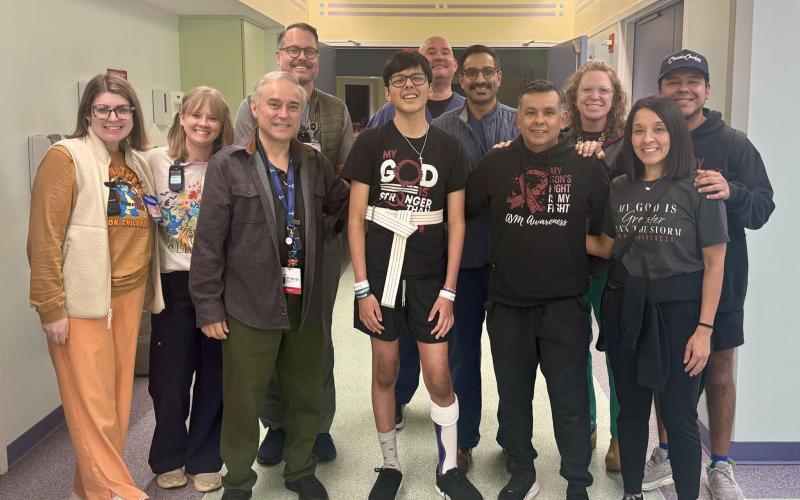 (BOBBIE JO MARRUFO | CONTRIBUTED PHOTO) The Marrufos have received an outpouring of support after their son Paul (shown at center) suffered a ruptured Arteriovenous Malformation in September. Paul is now working to recover from a successful brain surgery and is looking at his future.
 -
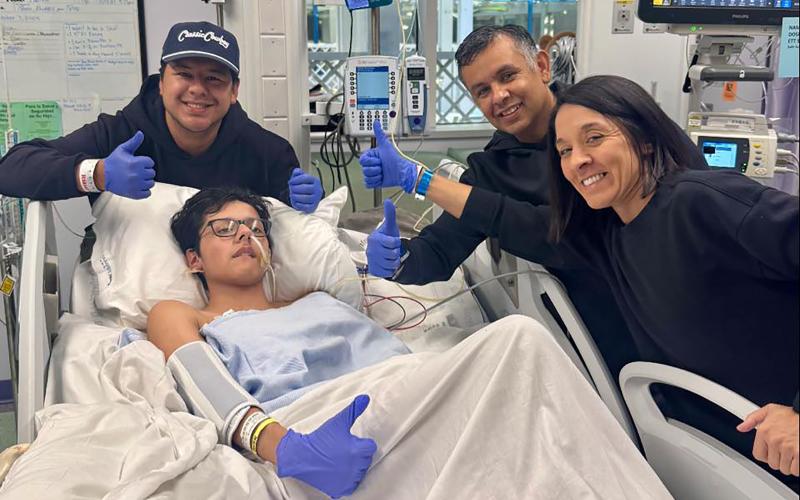 (BOBBIE JO MARRUFO | CONTRIBUTED PHOTO) Paul Marrufo has remained strong through a number of surgeries and procedures related to a ruptured Arteriovenous Malformation. Marrufo is now on a journey of recovery with support from the community behind him.
 -
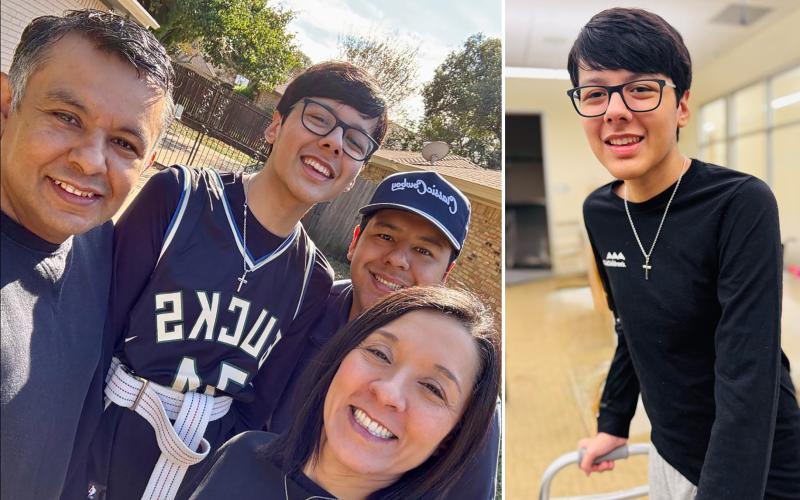 (BOBBIE JO MARRUFO | CONTRIBUTED PHOTOS) Paul Marrufo is on the road to recovery after suffering a ruptured Arteriovenous Malformation in September. While things looked grim in the beginning for the Marrufo family, Paul was able to undergo surgeries and remain strong into his recovery.
 -
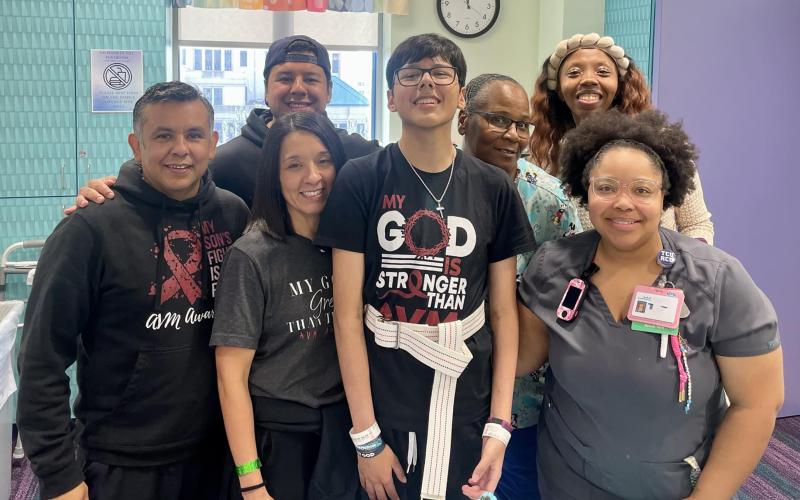 (BOBBIE JO MARRUFO | CONTRIBUTED PHOTO)
The Marrufo family will always remember Sept. 20 not only as the beginning of a life-altering event for Paul Marrufo, but the start of a journey that led him to a miraculous recovery.
It was Saturday, Sept. 20 when Paul was at home alone by himself in Graham and suffered a horrible headache which led him to lose control of his body and consciousness.
What caused his condition was a ruptured Arteriovenous Malformation (AVM) with bleeding occurring in his brain.
“We got home and we found him and he had collapsed and was unresponsive,” Paul’s mother Bobbie Jo said. “We called 911 and then we drove him to the emergency room in Graham once he had started seizing and his nose started bleeding. My husband and I just made the decision just to drive him there, instead of waiting for the ambulance to arrive.”
The ER staff quickly determined that it was a brain bleed and he was airlifted to Cook Children’s Medical Center in Fort Worth.
“Once we got there, the neurosurgeon that admitted him, diagnosed it as a Grade 5 AVM, which is one of the highest,” Bobbie Jo said. “...We were basically told that he was pretty much in grave condition, he was in a level four coma, and so his diagnosis was pretty bad. If he did come out of the coma, it was highly likely that his quality of life would be very poor.”
The second day at the hospital, doctors could not get Paul’s heart rate and breathing under control and they were worried they might lose him.
“His heart rate was dropping and they weren’t sure why his heart rate was dropping. It’s almost like his body was shutting down,” Paul’s father Pedro said. “They couldn’t really give him a lot of medication to bring the heart rate up. They didn’t want his blood pressure to spike because that could trigger the brain bleed to re-bleed.”
The hospital inserted an External Ventricular Drain (EVD) into Paul’s skull to relieve the pressure.
“His veins and his arteries were pretty much in a knot and one of them ruptured because of the pressure,” Pedro said. “He went into about a two hour surgery, where they installed an EVD, basically to drain the spinal fluid and the blood that was in his brain causing the pressure and then from there he went into ICU and was in critical condition.”
The doctors tried to determine if they could release pressure from Paul’s lungs but did not know if he would survive the surgery, so they decided to give him breathing treatments.
“From that point forward, it’s like he started slowly climbing this steep hill that he’s on. He wasn’t going down (and) started coming up,” Pedro said. “Day number four, he had an angiogram, which verified that it was a Grade 5 AVM. That gave the neural team the opportunity to come up with a plan of action as far as what was going to be the process going forward.”
The doctors were looking at brain surgery to remove the AVM in the first or second week in November, but in order for that to take place Paul had to get stronger.
They started to take him off of the sedation medication and took him off the ventilator and while his brain was involved in a coma, it was alert enough to make his body breathe.
Day seven is when a miracle happened for Paul and he woke up and started speaking.
“He had a brain injury, which is similar to a stroke so he had some weakness to his left side of his body–his left arm, mainly, and his left leg,” Pedro said. “Then from there, they said the next plan is he has to get healthy. He has to get strong enough to be able to withstand the surgery. So we stayed in the ICU for about three-and-a-half weeks.”
He moved to another floor of the hospital so they could wean him off of more medication and he had a feeding tube put in place. He needed to be able to eat a certain amount of calories before the tube could be removed and would need to be able to swallow whole food.
“Once he cleared all those steps, then they moved him to the neural rehab and he was having speech therapy, physical therapy, occupational therapy, group therapy, yoga therapy (and) clinical life therapy. And it’s like every day he started getting a little bit stronger,” Pedro said.
He started to move parts of his body and he was equipped with a brace.
The first week of November came around and another important decision had to be made–would Paul move forward with his surgery.
The chief of neurosurgery reviewed Paul’s case and felt confident he could perform the procedure due to the way his brain was healing and isolated the bleeding.
“We all discussed it, had a family meeting and everybody in the family said that we would go with the surgery and Paul gave us his opinion and we elected to go with the surgery,” Pedro said.
Following a two-to-three hour procedure to prevent the AVM from bleeding, Paul underwent an over 10-hour brain surgery.
“The doctor that performed it came out and said, ‘Everything went perfect,’ he was able to get all the AVM out and then we would have to just have another angiogram two or three days later,” Pedro said.
Pedro said tears of fear turned into tears of joy as he realized he would get to experience his son’s smile and laugh again.
It was disbelief that Bobbie Jo felt when hearing the result of the surgery.
“You’ve been pretty much scared for this long. ...But on the other end, we had been praying and God had just been answering every prayer. ...Just knowing that God had worked that miracle that we had been praying for from the very second that we found him,” she said.
Paul was placed back into the ICU and not even 24 hours after his brain surgery he was moved back up the rehab unit. The following day he was back at physical therapy and two to three days later he was cleared for discharge.
The family was home for around three days before going back to Fort Worth so Paul could undergo therapy at a facility that specializes in brain injuries.
“He’s been doing his physical therapy, occupational therapy and speech (therapy) and every day he’s getting stronger,” Pedro said.
Paul is up and walking and using a cane for more stability because his brain is still swollen. It could take up to one year for his brain to heal which is impacting his balance and vision.
Paul’s recovery and progress has been posted on social media with many tracking his condition as it developed. Many have followed his journey and provided prayers and support along the way.
“We had so many people come to the hospital to pray over us, to sit with us, to encourage us, and to make sure we were never walking this road alone,” Bobbie Jo said. “Friends, family and people we had never met brought snacks, drinks, gift cards and monetary support. We are so incredibly thankful. To God be the glory for every single person he placed in our path.”
Along the way Paul’s parents stood beside him along with his brother Pete who was the first to arrive at the Cook Children’s Medical Center. They were not the only ones who were supporting his progress.
“The amount of support, encouragement, and prayers poured over our family has been nothing short of amazing,” Bobbie Jo said. “There is no way we could possibly name every person - our community, so many churches, and people from all over the country have covered us in love. We felt every prayer, every message, every act of kindness and we are so grateful.”
Throughout the entire ordeal, Paul has remained strong with a smile on his face and determined to get better.
Each year he assists his father, an officer with Graham Police Department, in handing out toys at the Toys for Tots distribution and has set a goal to keep up that tradition again this year.
As he gets stronger, Paul has set a goal that he wants a future where he can help animals like he was helped.
“I always liked animals and what made me realize how much they mean to me is the day that it happened. I remember walking to my room and I called my dog as I was in excruciating pain. I remember kneeling down telling him, ‘You’re my pride and joy. Don’t you ever forget that,’ and then that’s when I collapsed. After that, it really made me think to myself, that’s my everything. So to be able to help someone else is, to me, the perfect job,” Paul said.