-
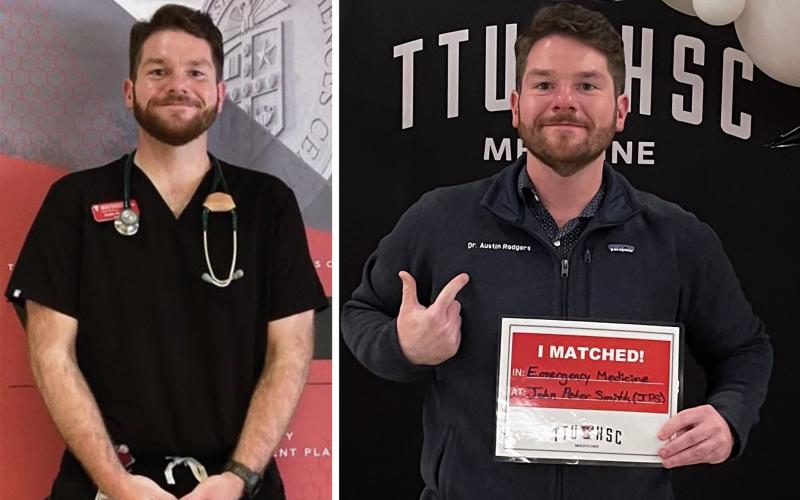 (AUSTIN RODGERS | CONTRIBUTED PHOTOS) Shown at right, Austin Rodgers receives his hospital assignment after graduation on match day 2025. Rodgers is currently recovering from two cases of cauda equina syndrome and continues to look for community support during this time.
Austin Rodgers, a bright young man from Graham who was just beginning to live out his dream, now needs support from the community he calls home after an unexpected health crisis.
Rodgers had just graduated this past spring from Texas Tech with a master’s degree in Biomedical Science and started his time as an Emergency Medicine Resident Physician at John Peter Smith Hospital in Fort Worth.
However, in September, Rodgers life was flipped completely upside down. On Wednesday, Sept. 10, Rodgers felt pain in his back after thinking he had potentially pulled a muscle, but it went away the next day.
Then on Friday, Sept. 12, Rodgers started to feel numbness and tingling in his feet. The two days that followed saw Rodgers feel more intense numbness in his right leg and then Rodgers developed what he described as “saddle anesthesia” which is a loss of sensation in the lower half of the body.
“That’s when I realized, hey this is something actually serious and I needed to get it checked out,” Rodgers said.
After a trip to the emergency room and an MRI, doctors revealed that Rodgers had developed cauda equina syndrome. This is a rare condition where nerve endings on the spinal cord become compressed causing the symptoms that Rodgers was experiencing.
Rodgers said the condition was caused by his L4 and L5 vertebrae discs being blown out and putting pressure on his spinal cord.
The severity of this condition if left untreated can be significant with long term effects like permanent paralysis being a possibility.
“I was scared,” Rodgers said when learning of the condition. “With cauda equina, this was one of those emergencies we learn about that you need to get handled right away.”
Rodgers was taken into emergency decompression surgery following the diagnosis, and after being discharged was starting to see steady signs of improvement.
He could move freely with the assistance of a walker and was starting to get his strength back. That was until Friday, Sept. 19.
Rodgers was spending time with his girlfriend Addie Klemm, when he started to feel what he described as “bone shaking chills” and picked up a fever over 100 degrees.
The young man went back to the hospital for a follow-up and it was discovered that the area where the surgery was performed had become infected. This led to a pooling of blood around the surgical area which caused Rodgers to develop cauda equina syndrome for a second time.
After performing a second surgery, the infection was handled and the blood was drained from his spine; Rodgers is back on the road to recovery once again.
It has been a mix of rest and physical therapy for Rodgers in order to try and finally move on from this ailment, however what has also kept Rodgers in high spirits has been the ongoing support he’s been receiving from those close to him as well as the surrounding community.
Rodgers’ girlfriend, Klemm, has been a steady presence for him throughout this time, keeping his home and affairs in order as he recovers. She has also been trading off shifts of her own hospital work to continue to spend time with him during the two stints he had extended hospital stays.
Rodgers also credited the members of his residency program for each taking the time to visit him while bringing him gifts and telling him about their days to help brighten his spirits.
One of those program members, Spencer Heath, is also from Graham and Rodgers gave him praise not just for being there for him during this time, but also for providing a sense of home and familiarity.
However, arguably the most profound impact Rodgers has felt in all of this has been the continued support he’s been receiving from the Graham community as a whole.
Rodgers has put out Facebook posts updating his status to those he knows, but his parents have also posted in community groups about his condition and frequently asked for prayers and support.
The support has been overwhelmingly positive, according to Rodgers, with him getting messages from a wide variety of people. Whether that be those he knows very well, those from his past who he’s had the opportunity to catch up with, or even complete strangers wishing him the best and cheering him on.
“It makes me feel really cared for,” Rodgers said. “It can be really easy to get into the mindset of this really sucks, this is really hard, a type of woe is me this isn’t fair situation. Having these people shifts that perspective because it shows there are really good people out there trying to help and that this is a temporary moment. There’s still really good people out there.”
Doctors have told Rodgers to estimate a six-week recovery time from this experience, and while his status at the end of that road isn’t fully certain yet, Rodgers and his family will continue to look for support as he continues to take this journey.