-
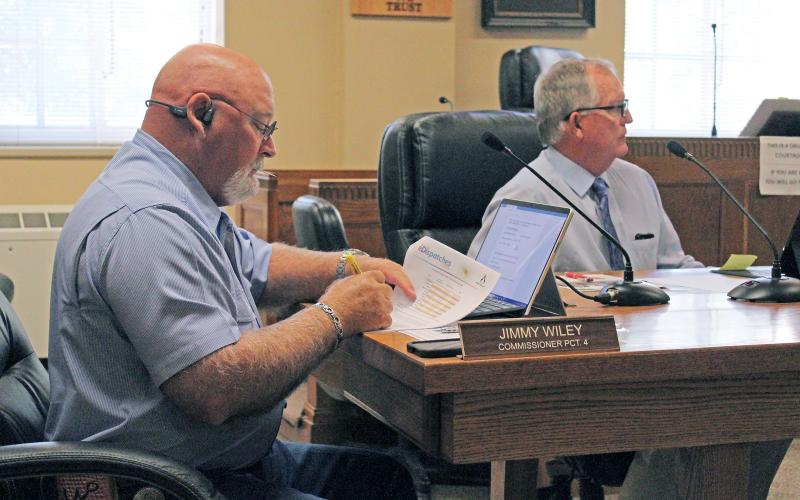 (TC GORDON | THE GRAHAM LEADER) Young County Commissioners Jimmy Wiley (left) and Stacey Rogers (right) listen to a presentation during the commissioners court meeting Monday, Aug. 19. The county will hold public hearings and potentially vote on the fiscal year 2025 budget and tax rate at 9:30 a.m. Monday, Aug. 26.
 -
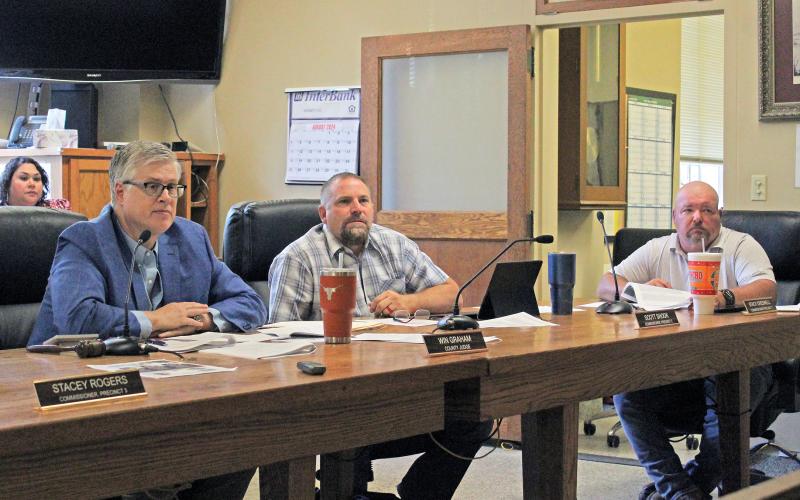 (TC GORDON | THE GRAHAM LEADER) Young County commissioners have completed their proposed budget for fiscal year 2024-2025 and will hold public hearings on the budget and tax rate at 9:30 a.m. Monday, Aug. 26 at the Young County Courthouse, 516 Fourth St., Room 106.
Editor’s Note: This is part two of a two-part story regarding the upcoming budget for Young County.
As the current fiscal year nears a close, Young County is finishing preparations for the new fiscal year.
County commissioners will hold a public hearing for their proposed tax rate and budget at 9:30 a.m. Monday, Aug. 26 and they will consider adoption of both following the close of the hearings. These hearings will both occur at the Young County Courthouse, 516 Fourth St., Room 106.
A proposed tax rate of $0.63 per $100 valuation was published in a public notice in The Graham Leader. This would be a 7.2% increase over the current tax rate of $0.587674 per $100 valuation.
However, County Judge Win Graham filed the proposed budget with a rate of $0.58696 per $100 valuation, even though commissioners have not taken an official vote to propose the lower rate.
According to the published public notice, commissioners and Graham voted unanimously Monday, Aug. 5 on the proposed rate of $0.63 per $100 valuation.
For transparency, all numbers in this story will reflect the tax rate of $0.58696 per $100 valuation Graham has proposed in the public budget. This would be a 0.12% decrease under the current tax rate of $0.587674 per $100 valuation.
Last week, part one of this story included information regarding certain aspects of the proposed budget such as precinct budgets regarding equipment purchases and changes in jury fees.
This story contains more information regarding various portions of the proposed FY 2025 budget.
The Young County Sheriff’s Office will benefit from state funds provided by the Senate Bill 22 grant, which gives $350,000 to qualified rural sheriff’s departments who apply. These funds can be used for vehicle and equipment purchases, as well as salary adjustments for qualified positions.
In addition to YCSO, the district attorney and county attorney offices were eligible for SB 22 funding, which came out to $175,000 for each office.
The stipulations for how these funds can be dispersed are different for each department, with YCSO able to purchase equipment and provide temporary salary adjustments, while the attorneys offices primarily used the funds for salary adjustments.
YCSO spent a large portion of the grant money on new equipment, such as new bulletproof vests, guns, tasers, body cameras and vehicles. The remainder of the money was used on temporary salary adjustments.
The district attorney’s office was able to use the entire sum of $175,000 for salary adjustments for each position in the office, while the county attorney’s office only used $17,367 and the rest of the money will have to be returned to the comptroller’s office.
In the new fiscal year, all three departments have budgeted for SB 22 funding again, with YCSO and the district attorney’s office expecting to allocate the total amount, while the county attorney will likely only use a portion again.
The YCSO budget decreased for the coming year to $2,118,691 from $2,158,865 last year. However, one of the large expenditures in that office is the purchase of new vehicles and equipment, budgeted for $425,000.
All county employees will receive 5% cost-of-living raises in the coming fiscal year which increases the total amount the county spends on salaries and benefits.
The total amount of money spent on current employee raises will be $310,929.
As for new positions the county created, these additional salaries and benefits add up to $227,339. The average salary among all full-time county employees is $50,684. This includes elected officials as well as appointed full-time employees.
There were also staffing changes such as part-time positions transitioning to full-time roles and the creation of new positions. For example, the district clerk’s office moved a part-time deputy clerk to full-time, which increased the salary for that spot from $15,000 to $42,305 in the coming year.
The county auditor and county tax assessor-collector’s offices will each have new assistant positions created for a combined added increase of $93,518.
In addition to salary increases in every office, smaller increases to budgetary items include things like increases to car allowances in the justice of the peace offices and cell phone allowance increases in the county auditor, tax assessor-collector and courthouse maintenance offices.
Following the conclusion of the public hearings for the tax rate and budget, county commissioners may vote to take action. This includes adopting, changing or postponing action on the budget for no more than seven days.