-
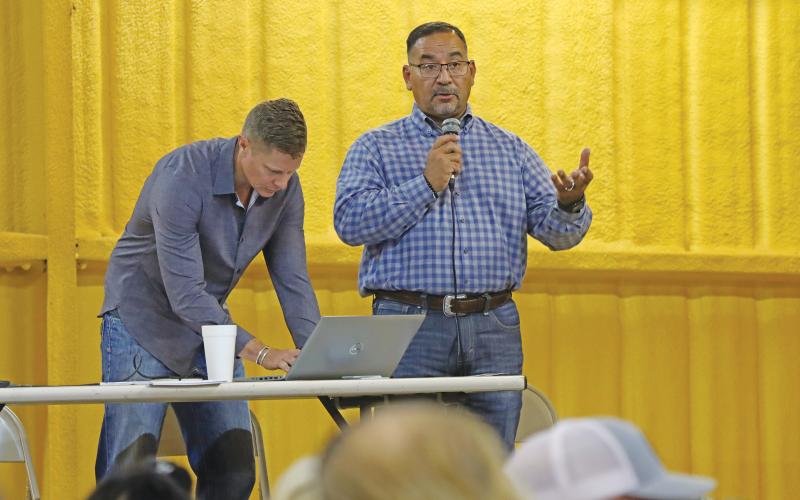 (KYLIE BAILEY | THE GRAHAM LEADER) Texas Energy Consultants President Robert Peña (right) and Titus LCV Senior Director of Engineering Micah Nichols (left) met with the community Wednesday, Nov. 5 to hear concerns and answer questions regarding a solar and battery storage project.
 -
 (KYLIE BAILEY | THE GRAHAM LEADER) Cookee Johnson speaks at town hall Wednesday, Nov. 5 regarding the proposed solar and battery storage project from Titus LCV. Young County is currently in talks with Titus LCV regarding a potential tax abatement for the Tapaderos solar project, a 2,600-acre, 300 megawatt solar power facility with 200 megawatts of battery storage seven miles west of Eliasville.
As a way to provide information and a venue to address community questions, Titus LCV, the developers behind a solar and battery storage project in Young County, held a town hall meeting last week.
Young County is currently in talks with Titus LCV regarding a potential tax abatement for the Tapaderos solar project, a 2,600-acre, 300 megawatt solar power facility with 200 megawatts of battery storage seven miles west of Eliasville.
An abatement is the full or partial exemption of taxes of certain property in a reinvestment zone designated by the county for economic development purposes.
A 10-year abatement was initially requested by the company which would begin after the commercial operation date which is estimated for the fourth quarter of 2028.
The town hall was held Wednesday, Nov. 5 at the Eliasville Volunteer Fire Department.
Attending were members of the Young County Commissioners Court as well as Texas Energy Consultants President Robert Peña and Titus LCV Senior Director of Engineering Micah Nichols.
“Our purpose tonight is to build a relationship with the community to understand your feedback, and for you to understand the project more,” Peña said. “There’s still development processes that need to unfold. There’s still finance processes that need to unfold. We’re making every concerted effort in parallel for the project to continue to move forward.”
Texas Energy Consultants is an advisory firm for Titus LCV and Peña serves as a financial consultant. Nichols supports the construction planning and engineering as well as choosing the technology for use in the project.
The two representatives were posed a number of questions from the community including those related to the county abatement, environmental impacts, construction and safety.
In the company’s abatement discussions with the county they are establishing a local spending and local jobs plan to make an effort to hire locally.
Peña said the lack of a county abatement would not kill the project but move it further out on a priority list for Titus LCV.
“It does not change Titus’ development proposal. It will actually change the financial outlook that then Titus begins to consider in what order they will develop,” Peña said. “Currently, Titus has a dozen or so projects in development or in process throughout the state of Texas, some ahead of others. …Titus would reconsider the level of where that project falls.”
Titus LCV has spent two years working through the development stage with environmental impact studies and how the project will connect to the electrical grid. The company obtained both local utility and ERCOT grid interconnect approvals.
The company completed a critical issues analysis and will start phase one of their environmental assessment in January 2026 with the process taking around a month to complete.
“We are moving forward with the electrical, the civil and the structural design packages as we go into Q1 …and then we would be starting to award to a contractor. And then the contractor would be applying for the building permit. We as the developer would be supporting any kind of county road use agreements, if applicable,” Nichols said.
The company has lease commitments from property owners with mineral rights owners leases around 90% complete. The project will have an estimated construction time of one year, weather permitting, with construction not planned to take place 24/7.
During construction there will be 100-250 fulltime jobs available, with two or more available permanent employees once completed.
The solar panels are designed for a 20-25 year life cycle and in the case that the company went defunct or was abandoning the project, all materials would have to be removed and the land restored.
“The project has to be completely removed and the land returned to the landowner with nothing on there,” Peña said. “...The company has to set a bond as financial protection to the landowner. Should the company go bankrupt, the bond will remain in place to assure the landowner that the facilities would be removed by that bond. That is a mandate now also by the state of Texas.”
Removal of the equipment would have to happen within one year which would be included in the landowner lease agreement.
The battery storage will be in shipping containers and will be used to store energy from the solar farm and used on the grid when necessary.
“It helps with the resiliency of the grid for the local area, but it also helps put (power) onto ERCOT lines when it’s needed,” Nichols said.
The battery storage units have an internal fire suppression system with sensors to detect when things would be heating up. A foam and chemical agency would suppress any fires.
The company will be meeting with local first responders about emergency incidents well before construction begins.
“A pre-construction meeting (will be held) with EMS, 911, sheriff’s department or constables department that conducts the patrols and the Murray and Eliasville volunteer fire departments. The purpose for this is for everyone to understand the needs for the safety requirements and also understand any additional requirements that cannot be met,” Peña said.
Peña said that Titus LCV could also financially support volunteer fire departments with a contribution that will help them improve their equipment.
The batteries within these storage units will degrade and have a lifespan of 15 years and are replaced and recycled. The storage units are built to contain hazards.
“They are built and constructed... (in) essentially like a sea crate or a shipping container, and they themselves can contain any kind of spill coming out of the batteries themselves,” Nichols said. “It’s not liquid within there, so it can’t just drain out.”
One concern was raised about a landowner overlooking the property and seeing the project. Nichols and Peña said there will be a buffer zone around the project.
“This isn’t wind power so you don’t have these giant structures that are sticking up, which can be seen for miles,” Nichols said. “These structures are roughly 12 feet at the tip height of the solar panel themselves. We have a plan to have setbacks, meaning there’s going to be vegetation in between where you’d be able to see it.”
An audience member that lives near a property associated with the project raised concerns about movements on the property and if the project had started.
Nichols said the project has not substantially started, but an access road was created to access the project area for studies
“The road was a necessary discussion with the landowner for purposes of our use to conduct studies. It does not indicate substantial start of construction,” Peña said.
Part of their engineering and civil design on the project is a Storm Water Prevention And Pollution Plan with Texas Commission on Environmental Quality to keep soils from running into creek beds, ponds or other similar local areas.
As far as sound, Nichols said when the solar moves to an inverter a sound near 79 decibels would be emitted, which would be less than that of a lawnmower.
While the project has received a total of 1,200 additional acres of neighbor requests to be a part of the project, Titus LCV has had to shut those down due to expansion not being currently possible with the project.
“We perform interconnection studies with Oncor and ERCOT to determine how much energy can be placed on the grid in this specific area, and we cannot put any more energy on the grid so therefore grow the project,” Nichols said. “It is capped at where it’s at unless ERCOT built a huge transmission line through here, and that’s not in our planning, nor are we aware of anything like that.”
Cookee Johnson and her husband Arwin who own property adjacent to an area included in the proposed project have voiced opposition since the beginning.
While she said she is against the project, she said Peña has been more than accommodating to answer questions and community concerns.
“Every one of you has legitimate concerns, and I understand that. I’m with you. I don’t want it. Robert knows I don’t want it. But if it’s going to come, I want Robert to be at my beck and call if I have a question and he said he will, and I really think he will for you as well, because this is going to be in our backyard,” she said. “If we’re fighting something, let’s fight the data center. …We did meet with Robert, and he’s a good guy, and he’s trying to help us through this.”