-
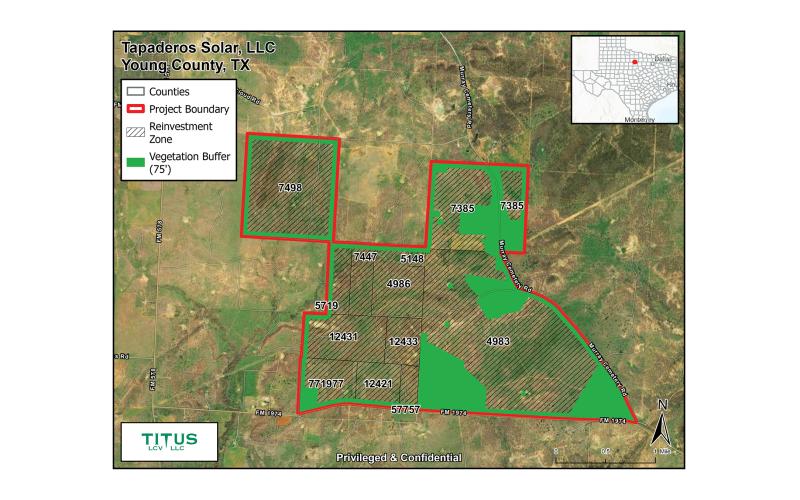 (ROBERT PENA | CONTRIBUTED PHOTO) Properties that are included in the Titus LCV Tapaderos solar and battery storage project that is being proposed in Young County. The green on the map shows the vegetation buffer that will be included with the project while the red is the project boundary.
 -
 (KYLIE BAILEY | THE GRAHAM LEADER) Texas Energy Consultants President Robert Peña (right) and Titus LCV Senior Director of Engineering Micah Nichols (left) met with the community Wednesday, Nov. 5 to hear concerns and answer questions regarding a solar and battery storage project. A public hearing regarding a reinvestment zone will be held Jan. 12.
In less than two weeks the Young County Commissioners Court will consider granting a reinvestment zone regarding a potential abatement for a solar and battery storage project.
The commissioners met Monday, Dec. 8 and approved starting a schedule to discuss and consider designating a reinvestment zone for the project and a tax abatement agreement regarding the Tapaderos solar and battery storage project from Titus LCV.
A public hearing is scheduled for 10 a.m. Monday, Jan. 12 for designating a 2,754-acre area in southwestern Young County as a solar reinvestment zone. Following the public hearing, the commissioners will consider taking action on designating the reinvestment zone.
Two weeks after the reinvestment zone meeting, there will be another commissioners court meeting at 10 a.m. Monday, Jan. 26 with an agenda item to discuss and consider entering into a tax abatement agreement.
Young County is in talks with Titus LCV regarding a potential tax abatement for the project seven miles west of Eliasville.
An abatement is the full or partial exemption of taxes of certain property in a reinvestment zone designated by the county for economic development purposes.
The project is anticipated to be in operation no later than Dec. 31, 2028 and within a draft abatement agreement it is stated that if commercial operation is not achieved before Jan. 1, 2029, the county will cancel the agreement.
During the 10-year abatement period, 100% of county property tax on the certified appraised value of the property will be abated.
The company will make Payments in Lieu of Taxes (PILOT) to the county each year along with a one-time payment of $300,000 for the county volunteer fire departments and $300,000 for the Young County Sheriff’s Office within 30 days of commencement of construction.
PILOT payments will be due at Jan. 31 of the calendar year following the one where the abatement is in place.
The Tapaderos project includes a solar power generation facility with capacity generation of approximately 300 MW along with a battery storage component with capacity of 200 MW.
The PILOT for the solar component is based on megawatts of nameplate capacity of generation (or $2,439 per MW) and for the battery storage is for nameplate capacity of two-hour storage (or $1,028 per MWH).
For the solar that comes out to $2,439 times 300 MW of solar capacity, or an annual PILOT of $731,713 paid to the county. For the battery storage that comes out to $1,028 times 400 MWH of two-hour storage, or an annual PILOT of $411,200.
Together that PILOT is an annual county payment of $1,142,913 and over a period of 10 years would be $11,429,130.
Titus LCV has spent two years working through the development stage with environmental impact studies and how the project will connect to the electrical grid.
The company obtained both local utility and ERCOT grid interconnect approvals.
The company completed a critical issues analysis and will start phase one of their environmental assessment in this month with the process taking around a month to complete.
During a town hall meeting for the project in November, Texas Energy Consultants President Robert Peña said the lack of a county abatement would not “kill” the project but move it further out on a priority list for Titus LCV.
“It does not change Titus’ development proposal. It will actually change the financial outlook that then Titus begins to consider in what order they will develop,” Peña said. “Currently, Titus has a dozen or so projects in development or in process throughout the state of Texas, some ahead of others. …Titus would reconsider the level of where that project falls.”