-
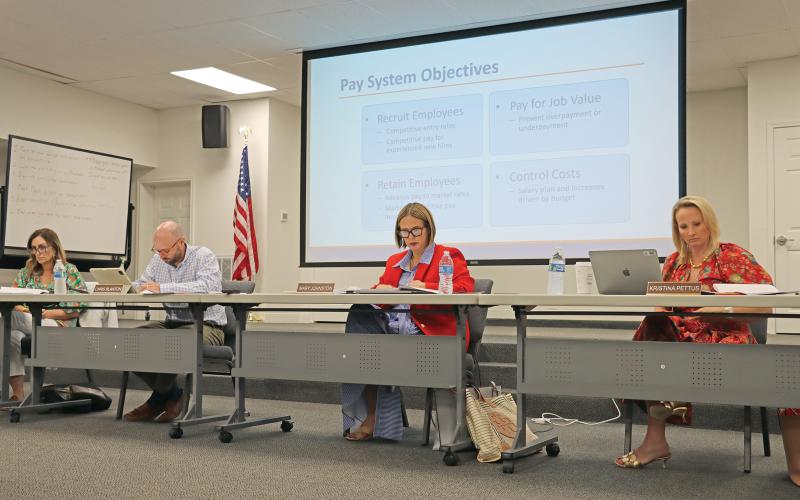 (THOMAS WALLNER | THE GRAHAM LEADER) Members of the Graham ISD Board of Trustees hear a presentation from the Texas Association of School Boards regarding a pay scale review of the district. Shown from left to right are Lauren Mahaney, Chris Blanton, Dr. Mary Johnston and Kristina Pettus.
The Texas Association of School Boards conducted a pay system review of Graham ISD and presented recommendations to the school board last week.
The Graham ISD Board of Trustees approved the pay system review in November that would look at district pay scales and compare it to peer districts.
TASB HR and Compensation Consultant Lauren Wurman presented the findings to the school board Wednesday, May 14.
TASB recommended the district improve pay equity, improve their market competitiveness and align their midpoint pay with the market.
The company reached out to 20 districts to compare teacher pay with 15 participating in the review. On average, GISD teachers have around 15 years of experience which is higher than the state average of around 11.1 years.
“The average number of years that your teachers are staying in Graham ISD is about eight and a half, which is also wonderful,” Wurman said. “We’re seeing a lot of movement of people moving to districts, and also moving outside of education altogether. And so to have an average district year over five is phenomenal.”
The compared districts ranged in size from small districts such as Woodson ISD with an enrollment of 162 to medium one such as Jacksboro ISD with an enrollment of 1,083 and large such as Decatur ISD with an enrollment of 3,766.
The pay system review also found that newly hired teachers were not without teaching experience.
“You had 19 teachers that were new to Graham ISD during the 24-25 school year. ...We do not have an abundance of brand new teachers that we are seeing in many districts that are not able to find certified teachers, and we see a majority of your teachers that came in this year had anywhere between six years of experience up to 10 years of experience,” Wurman said.
At zero years of experience for teachers, GISD is 1% above the market median, or $250. At five years, the district is 1% below the market median, or $500 below. The lowest point in the district teacher salary schedule is at 10 years, which was 2% below the market median value, or $1,240.
“It starts out slightly above the market median at zero year, it dips below the market median ever so slightly at years five and 10 and then matches that market again at year 15 and then exceeds the market just a little bit at year 20,” Wurman said.
Three models were provided to the district with a general pay increase of 1-3% for all job groups.
As a starting point, TASB provided some cost models before changes within the legislative session, but will provide updated cost models to districts in the future.
“We don’t want districts to adopt any proposed pay structures at this point and then have to go back and change it in order to be in compliance with any mandates that come out of (the legislative session),” Wurman said. “…We are waiting at TASB until that is all finalized and they make a decision, and then as soon as everything is finalized we are prepared to move very quickly to make sure that we get pay structures to our districts.”
With the preliminary cost model presented, a 1% increase would be an estimated total cost of $352,561, a 2% increase would be an estimated total cost of $481,733 and a 3% increase would be an estimated total cost of $620,683.
The pay system review also looked at stipends provided by the district to various teaching and other staff members.
Stipends for secondary math, secondary science and special education - high needs are below the market median for the district, while it matches for hires with a master’s degree, bilingual hires ESL - general hires. The district also provides $1,600 more than the market median for foreign language stipends.
TASB recommended increasing stipends for hard-to-fill teaching assignments such as the special education high needs which they recommended increasing from $2,500 to $3,000 to improve competitiveness.
The organization also recommended GISD stop paying stipends to nonexempt employees and to review stipends against the market value every two to three years and adjust as needed for market competitiveness.