-
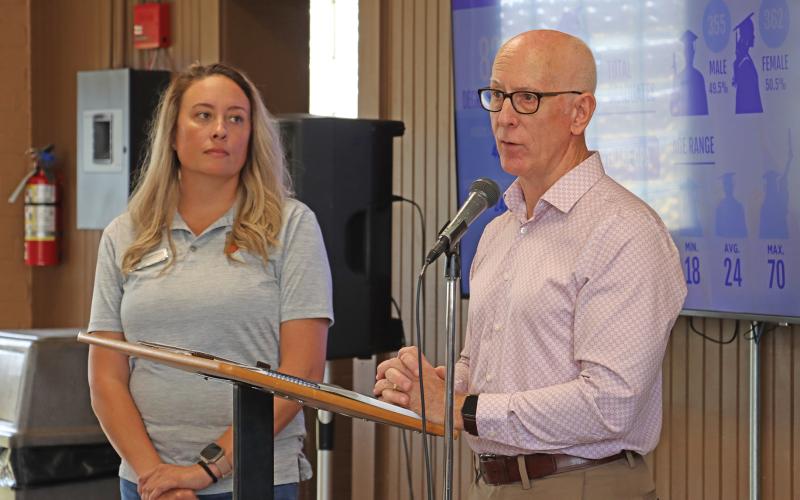 (THOMAS WALLNER | THE GRAHAM LEADER) Wichita Falls Area Food Bank CEO David O’Neil speaks during an informational luncheon Tuesday, Aug. 12 regarding SNAP changes and shifts in their organization. The organization provides services to a 12-county area, including Young County.
 -
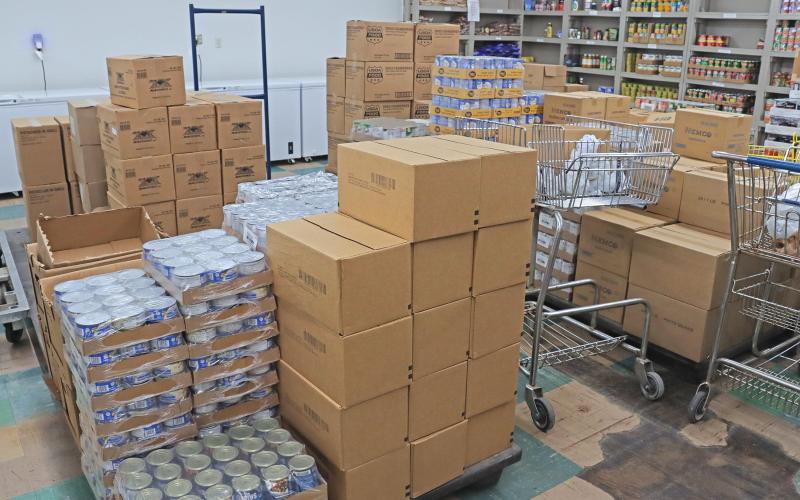 (ARCHIVE PHOTO | THE GRAHAM LEADER) A storage area for the food at the Graham Community Food Pantry. Last month, the organization served 440 households and 1,386 individuals and handed out 24,474 pounds of food.
Representatives from the Wichita Falls Area Food Bank spoke with local volunteers and leaders regarding the impact of the passage of H.R.1 “One Big Beautiful Bill Act,” on their operations and support.
WFAFB CEO David O’Neil and Community Partner Director Cassandra Barraza spoke Tuesday, Aug. 12 at North Central Texas College with volunteers from the Graham Community Food Pantry and local leaders.
The act signed into law Friday, July 4, was said previously by WFAFB to have an impact on thousands across North Texas to access affordable food, driving them to local food banks.
In July, the Graham Community Food Pantry served 440 households and 1,386 individuals and handed out 24,474 pounds of food. During this same month the organization had 52 households sign up for the food pantry program.
In the state of Texas, SNAP is supplied through a Lone Star Card that can be used similar to a credit card at any store that accepts SNAP.
These funds cannot be used to purchase tobacco, alcohol or to pay for owed food bills or purchase of items that cannot be eaten or drank. SNAP benefits can be used to purchase food online.
Those in low-income households are eligible for SNAP benefits if they fit within the family size maximum monthly income requirements. The maximum amount a family receives is also based on family size, with a one-person household eligible for $291 and a four person household eligible for $973.
“There’s $186 billion that is cut out of the federal budget over the course of 10 years, starting in fiscal year 2028 which would be Oct. 1. ...With a lot of that money there’s a cost shifting that’s occurred with that,” O’Neil said.
The cost shifting referred to by O’Neil was the change related to the payment error rate measure of how accurately states determine who is eligible for SNAP benefits and allotments.
“That doesn’t mean fraud. It doesn’t mean abuse. It just means that somebody in a cubicle in Austin or someplace didn’t get it right when they were processing the application. They could be giving them too much money. They could be giving them too little money,” O’Neil said.
Under the law beginning in fiscal year 2028, if the payment error rate of a state is less than 6%, the federal share of the cost will be 100%. If states exceed that amount, they will be on the hook for a portion of the food benefit cost.
If that percentage is between 6-8%, the federal share of the cost will be 95%. If the percentage is between 8-10%, the federal share of the cost will be 90%. If the percentage is equal or is greater than 10%, the federal share will be 85%.
“All indications are it’s going to create more people in line at the food bank at the (Graham) Crisis Center. It just is (and) I don’t know any way around that,” O’Neil said. “The other thing that it also does is, if somebody applies for SNAP today... it could be up to six months (waiting).”
The national payment error rate for fiscal year 2024 was 10.93%, while the state of Texas’ error rate for the same period was 8.32%.
Other changes include limiting adjustments to the Thrifty Food Plan, putting seniors up to age 65 and parents on the three-month time limit requiring they document 20 hours of work to receive benefits.
WFAFB has worked over the past year to procure food in a different way to cut costs that will also impact individuals locally.
O’Neil gave examples of free truckloads of food from the Kellanova, formerly the Kellogg Company, and the Church of the Latter Day Saints.
“A full truck load is typically 40,000 pounds. That’s food that is free, doesn’t cost us anything. We don’t even have to sort it. We just put it on the rack, put it out there for (Graham Crisis Center Director) Joy (Petersen) to be able to purchase and we distribute it,” O’Neil said.
One major change for the organization is that they used to buy food in bulk, but the cost was too high and food had to be bought by the truckload. WFAFB transitioned from canned goods to fresh produce.
“Now, not everybody has refrigeration. We get that, but it’s been able to supplement where we can still provide the food without having such a high expense,” O’Neil said.
Additionally, the WFAFB social service team was reduced to Haskell, Knox and Foard counties. In the past, the organization would have an employee in Graham each Tuesday which would help residents sign up for programs, but that will no longer be the case.
“That does not mean that we are not going to continue to serve all 12 of our counties with social services. It means that we will be limited,” O’Neil said. “...We can still do government applications for everything. We cannot have a set table set up at the food pantries. We can’t have a set schedule. We can do phone calls with individuals that are wanting help. We can help them upload their documents.”
As these changes occur and SNAP benefits become harder to obtain, food banks will continue to struggle.
“Our 12-county area, out of 200 Feeding American food banks, has the 15th highest hunger rate or food insecurity rate in the entire country,” O’Neil said. “We have an issue here in North Texas around food. One in four children experience hunger. One in five adults experience hunger.”
WFAFB distributed a total of 713,641 pounds of food to Graham from 2021-2023, with a total of 288,114 pounds distributed in 2023.