-
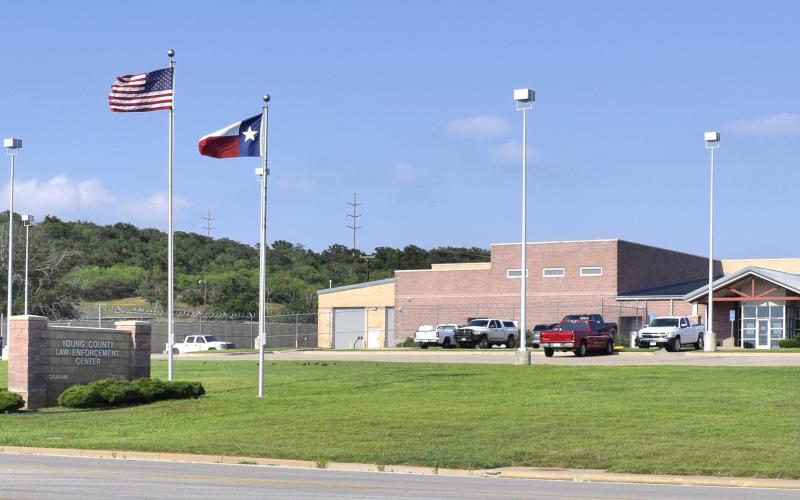 (ARCHIVE PHOTO | THE GRAHAM LEADER) The Young County Sheriff’s Office has signed an agreement with ICE which will provide its law enforcement officers with immigration authority.
The Young County Sheriff’s Office signed an agreement with ICE which will provide training and authority to its deputies as immigration officers.
Texas Senate Bill 8 was passed June 20, 2025 and effective Jan. 1, 2026 and implemented requirements for sheriffs to comply with the Delegation of Immigration Authority Section 287(g) Immigration and Nationality Act.
Under SB 8, the sheriff of each county that operates a jail or contracts with a private vendor to operate a jail is required to request and enter into an immigration law enforcement agreement to authorize the sheriff and applicable employees to enforce federal immigration law.
“Gov. Abbott mandated that local law enforcement agencies, specifically sheriff’s offices, cooperate and participate in the 287(g) program,” YCSO Lieutenant Will Cauthern said.
The attorney general may bring action against a sheriff in district court who fails to comply with SB 8 and enter into an agreement. The action would be brought before the district court for the county served by the sheriff.
Young County Sheriff Travis Babcock signed a Memorandum of Agreement (MOA) on Tuesday, Jan. 20 to have eligible deputies be trained in the program. The MOA is effective upon the signature of both the sheriff and ICE and remains in effect until either party terminates or suspends the agreement.
The models for the 287(g) program are the Jail Enforcement Model, the Task Force Model, the Tribal Task Force Model and the Warrant Service Officer.
YCSO chose the Task Force Model which allows the officers to enforce limited immigration authority with ICE oversight during routine duties. Cauthern said one of the benefits is it allows officers to assist with transporting individuals to holding facilities.
“It helps the guys on the street and the jail. The representatives we have with ICE, they’re based out of the West Texas, Abilene region, and there’s not a whole lot over there. So at times, it’s a big delay for us, whether we have somebody in custody or the guys on the street. So it will cut down drastically on that,” Cauthern said.
One of the authorized functions of the officers under the agreement is the authority to “interrogate any alien or person believed to be an alien as to his right to be or remain in the United States.”
“That is a part of what we have been doing already, is conducting those interviews with people on the side of the road to see if they are here legally and obtaining if they have any documents present to provide,” Cauthern said.
The officers will be able to make arrests without a warrant of any alien entering or attempting to unlawfully enter into the country in the officer’s presence or view, or any alien in the country, if they believe the arrested alien is likely to escape before a warrant can be obtained.
The officer will be able to serve and execute warrants for immigration violations as well as the authority to administer oaths and take and consider evidence to complete required alien processing.
Those required processing functions are fingerprinting, photographing, interviewing and preparing affidavits and sworn statements for ICE review.
YCSO officers will also have the authority to issue immigration detainers and I-213, Record of Deportable/Inadmissible Alien.
The officers will have the authority to take and maintain custody of aliens arrested by ICE, or another state or local law enforcement agency on behalf of ICE. Additionally, they will have the authority to transport aliens to ICE-approved detention facilities.
After notification and coordination with an ICE supervisor, an alien who has been determined by a local participating officer to be removable will be arrested on behalf of ICE by the officer or officers and be transported on the same day to a relevant ICE detention office or facility.
Under the agreement, law enforcement officers with YCSO will be trained and approved by ICE to perform functions of an immigration officer under the direction and supervision of ICE within Young County jurisdiction.
“Participating LEA personnel (will) be subject to ICE direction and supervision while performing delegated immigration officer functions pursuant to the MOA,” the agreement states. “For the purposes of this MOA, ICE officers will provide direction and supervision for participating LEA personnel only as to immigration enforcement functions as authorized in this MOA.”
Each law enforcement officer must complete mandatory training on administrative, legal and operational issues with immigration enforcement functions.
All YCSO participating officers must be United States citizens, have two years of law enforcement work experience, be approved by ICE and be qualified for appropriate federal security clearances and access to appropriate DHS and ICE databases, systems and associated applications.
Training includes discussion of terms and limitations within the MOA, scope of immigration officer authority, relevant immigration law, the ICE use of force policy, civil rights laws, the detention of aliens, public outreach and complaint procedures, liability issues, cross-cultural issues and obligations under federal law.
“A lot of it is understanding the legalities behind what you’re doing, the liabilities with the 287(g) program and going through what authorities the officers will have,” Cauthern said.
Local training on relevant issues will be provided on an ongoing basis by ICE supervisors or a designated team leader.
Trained officers who complete the training will be certified for two years from the date of authorization.
“A few of our guys have started the training. It is 40 hours, so I wouldn’t foresee any completions until probably the end of this week. It’s at your own pace,” Cauthern said.
Participating personnel are not authorized to perform immigration officer functions except when working under the supervision or direction of ICE. Officers may also be assigned and or located with ICE as task force officers to assist ICE with criminal investigations.
Participating personnel shall contact an ICE supervisor at the time of exercising their authority in the agreement, or as soon as is practicable thereafter, for guidance.
“The actions of participating LEA personnel will be reviewed by the ICE supervisory officers on an ongoing basis to ensure compliance with the requirements of the immigration laws and procedures and to assess the need for additional training or guidance for that specific individual,” the agreement states.
ICE officers will provide supervision of participating personnel only as to immigration enforcement functions, with all other aspects of the employment and performance duties remaining with YCSO.
“They’re still going to be under the direction of me, the sheriff. So it’s not like they’re just going to be running around and working for ICE,” Babcock said.
If a conflict arises between an order or direction of an ICE supervisor officer and the YCSO rules, standards, or policies, the conflict will be reported to ICE and the chief officer of the YCSO, or a designee. ICE and the chief officer of YCSO will attempt to resolve the conflict.
The sheriff's office will carry out designated functions of the MOA at their own expense, including salaries and benefits, overtime, security equipment, local transportation and official issue material.
While grants and reimbursements are available for vehicles, trained officers salary and benefits and overtime, Cauthern and Babcock said what actually becomes available through the program remains to be seen.
“It’s our understanding that some of the overtime hours are compensated. There’s stipends given for equipment, like IT equipment and for vehicles. All this has been over the phone. I haven’t received anything on paper, so it’s hard for me to say if the sheriff’s office will obtain x, y and z. I think for us, we’re in that capacity that we don’t believe anything until it’s actually happening,” Cauthern said.