-
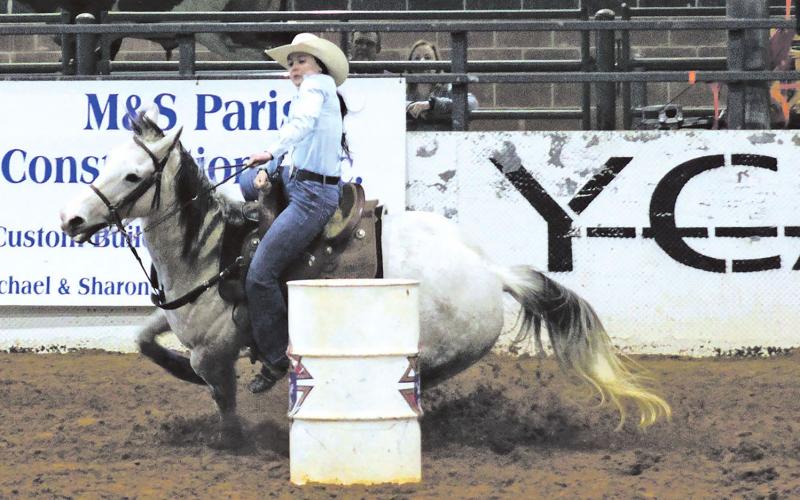 (ARCHIVE PHOTO | THE GRAHAM LEADER) Rylee Hardin, of Newcastle, competes in a barrel race event during the 2022 Knights of Columbus rodeo at the Young County Arena. The arena was closed this week until further notice out of caution due to the outbreak of Equine Herpesvirus-1 (EHV-1).
While no local cases of Equine Herpesvirus-1 have been reported, out of an abundance of caution the Young County Arena has been closed to horse events due to a recent outbreak.
EHV-1 causes an upper respiratory disease and abortions or stillbirths in horses. The virus can cause a neurological disease called equine herpes myeloencephalopathy, which can be fatal, according to the U.S. Department of Agriculture Animal and Plant Health Inspection Service.
An outbreak of Equine Herpesvirus-1 (EHV-1) is being linked to the Women’s Professional Rodeo Association World Finals held Nov. 5-9 in Waco, with cases being reported in horses that attended.
“It started in Waco at their facility. ...They had a barrel race at the beginning of the month and that's where the origin of it is coming from,” Young County Arena Manager Julie Elrod said. “It has a seven to 14 day incubation period, so that's why we're seeing it now and not sooner after the event.”
Commissioner Sid Miller and the Texas Department of Agriculture alerted Texas horse owners Wednesday, Nov. 19 to monitor their animals after the outbreak at the event in Waco.
“This virus can spread fast, it can be deadly, and the earliest signs are often so subtle they’re easy to miss,” Miller said. “That’s why monitoring your horses right now is critical. The quicker we identify a potential case, the better chance we have to protect not only our animals, but the entire Texas equine community.”
Other facilities in Texas and Oklahoma have also made the decision to cancel events such as the Uvalde Rodeo Qualifier in Uvalde, Texas scheduled for Nov. 17-22 and the Barrel Futurities of America World Championship scheduled for Nov. 15-22 in Guthrie, Oklahoma.
YCA was set to have a horse roping event Nov. 21-22 which was postponed due to the outbreak. Elrod said the team roping event was expecting around 1,500 teams and was too much of a risk.
“I talked to a few (Young County Arena) board members this morning (Nov. 19) and we were in agreement that it was the safest for everybody to cancel it for now,” Elrod said.
Other than motocross events, horse events make up the majority of events hosted at YCA with around 48 held throughout the year, according to Elrod. Both of the arenas at the facility were closed out of an abundance of caution.
“It is out of precaution that we're not having anything, because it is so highly contagious that your horse may not show any signs for two weeks and then you've already been to a facility and now you've exposed all of these other animals,” Elrod said.
The arena has another team roping event scheduled for Saturday, Dec. 13 and will continue to monitor the outbreak to see if they will cancel or postpone the event.
The first weekend in December the arena will still be hosting its annual motocross event, but equine events have been shelved for now.
“The problem is you don't know and then you go to Oklahoma and you go to a barrel race and then all of a sudden your horse is sick and now you've exposed another 100 head of horses and then that person leaves and goes to a different state. It just snowballs if you don't get a hold of it,” Elrod said.
The arena manager said they are doing their part to make sure they are disinfecting the facility.
“We will put bleach and Lysol in the floor machines to get the floors really clean. We have that really great inmate crew that will start mopping all the bleachers and floors with Lysol and bleach,” Elrod said. “There's a powder… (that we) put it in the water truck… and then we go through and spray all of the stalls, the back arena, the cattle pens and the alleyways with that chemical and we let it sit. We'll probably do it twice this time just to be sure.”
EHV-1 is spread via nose-to-nose contact, contaminated equipment and respiratory secretion within stalls and stables. Vaccines are available to prevent forms of EHV that cause respiratory illness and abortion.
“These vaccines reduce the severity of symptoms and viral shedding. They also reduce the risk of abortions. These vaccines are strongly recommended, especially in breeding operations,” USDA states on its website. “None of the vaccines are effective against the neurologic form of the disease.”
Horses that are returning to a farm after an event should be isolated for at least 21 days and monitored for signs of disease. Pregnant mares should be kept with foals at their side in small groups and away from new or returning horses.
Signs to look for include: fever, difficulty urinating, nasal discharge and cough, depression, head tilt, loss of tail tone, stumbling or weakness in the hind limbs progressing to all limbs, down and unable to rise and abortion in pregnant mares.
Regular cleaning and disinfection of water and feed buckets, mucking equipment and any other equipment is recommended.
Treatment of the virus consists of supportive care, with intravenous fluids and anti-inflammatory medicines to reduce fever. In severe neurologic cases, treatment can include hospitalization and intensive veterinary care.
USDA states that producers or owners who suspect an animal disease should contact their veterinarian to evaluate the animal or herd.